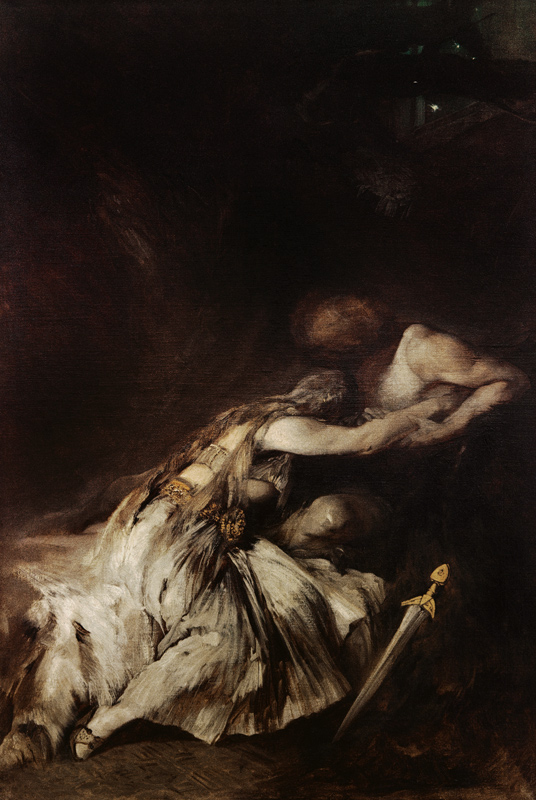
John Berger once wrote that the relation between what we see and what we know is never settled. In opera, when we add music and motion to what we see, which is to say, when we add time, that lack of settlement grows evermore murky and tenebrous until it becomes less like asking the questions, what am I seeing and what do I know, and more like trying through one’s besotted senses merely to control the experience in the event that one has finally caught, seen, heard, or understood something one might have missed. When the music in question happens to be the Ring, these long-for relations keep moving and moving like eddies in a swift river and there we are, standing in the shallows searching for patterns in what is, in reality, a force of its own making all while trying not to get too swept away in it.
This sense of being ‘carried away’, though it can be found in many places in the Ring (Siegfried’s journey through the forest and the Funeral March in particular come to mind), is perhaps at its strongest near the tail end of Act I of Die Walküre, when Siegmund and Sieglinde become locked in a continuous swirl of music, each moving ever-towards the other in a bind of such reckless yet enticing closeness, until, all of a sudden, this long, mutual seduction must be abdicated in pursuit of the truth, a truth that is both tonically heroic and hard to bear in theory, which is that the mighty sword embedded in the ash tree is meant for Siegmund, which can only mean that the woman bestowing it upon him must be Sieglinde, his own sister.
But this final revelation, one feels upon re-listen, comes a bit too late, which is perhaps why it also seems more than a bit shocking. After the curtain falls on brother and sister at the end of the first act, one finds oneself thinking: Really? No reflection on this matter at all? Just a rather out of character (for Siegmund, who is as soft as the fallen snow) pledge to the glory of a shared bloodline followed by a passionate round of coitus on the bearskin rug? Such a hasty conclusion only makes logical sense, at least to me, if these two people, in some way, perhaps one that is inarticulable, already know the truth about each other but are just now, at the end, speaking it aloud for the first time. This is the thesis around which this piece is based, and yet, here one remains especially confronted by that same problem, and the Ring’s special way of undermining of it: the relation between seeing, hearing, and sensing – and what we know.
This is true not just for us but for the characters as well. Throughout the cycle, they often find themselves swept up in a psychical dialectic in which the truth, whatever it may be, must be suppressed yet is irrepressible, so much so that it seeps from the crevices of metaphors, innuendos, and insinuations both textual and musical. Perhaps this is a situation, not unlike that of Siegfried’s musical searching for his mother, whose line to her lover, du bist der Lenz – you are the spring[1] – resurfaces among the sounds of a forest teeming with life, where the knowledge in question is so powerful it can only be sensed.
Indeed, the question of when – when exactly – the Wälsung twins recognize one another is, along with “Is Siegmund truly free?” or “Is everyone in the Ring directly cursed by its eponymous piece of jewelry?” among the most persistently frustrating points of debate in the entire work. While Siegmund may be the longform poet in the family, the task of identification instead falls to his sister, in part because she has the upper hand. Sieglinde, not Siegmund with his little song, is the one who establishes and substantiates the erotic bond that forms between her and her twin, for it is she who brings her brother to a conclusion they are both all too ecstatic to reach.
This is not only true because she goes a very long time without revealing any identifying information to Siegmund (hence rendering him almost completely ignorant to a situation she clearly isn’t) but also because it is her insinuations and probing inquiries that have a seducing quality to them, that ask the question, albeit in veiled terms, what if we really were the same? This is not to say that Siegmund himself is not a willing party (though his willingness comes off as rather abrupt in comparison) merely that he is not the mechanism by which this revelation comes to pass. He is, in reality, a very ambiguous lover despite how overt his advances are. One can go even more mad trying to figure out what he sees and knows.
The stakes of this ‘recognition question’ are not high in the general scheme of things, but they are high when it comes to understanding one of cycle's two key pairs of lovers, not only with regard to the tricky matter of the twins' consanguinaeity but to the broader analytical problem of eroticism itself, which is our primary concern here. Often the recognition of this eroticism, overt rather than covert in its incestuousness, is somewhat obviated by the other romantic content present in the opera, such as Siegmund’s sympathy for his sister’s plight or Sieglinde’s for the utter woe Siegmund has had to endure for beliefs that are, in every way, shape and form, righteous and good. This is not to diminish the emotional power of this sympathy and solidarity, to which we will return at the very end, but rather to make the argument that it is not the primary driver of the twins’ desire for one another.
In lieu of this sympathy, we must turn instead to the process of recognition. This process, so thematically integral to the love of the Wälsungs is, for the pair, also an erotic (or even an autoerotic) one. As I mentioned in the previous essay on incest, the twins’ love for one another is almost entirely rooted in sameness – physical sameness, political sameness, emotional sameness, and it is this sameness that shows up time and time again in the twins’ expressions of physical desire. Theirs is a fundamentally incestuous longing, and the mechanism by which it is revealed is, I will argue, also an expression of this quality as it is presented in both metaphysical and erotic fantasy. This does not, however, take away from its considerable staying power.
As for the question of when this process begins and ends, even careful retrospective analysis is stymied by the need to distinguish between foreshadowing, irony, metaphor, and innuendo. Because of the Ring’s unique structural character -- that famous totality comprised of infinitesimally small pieces -- what characters know explicitly, innately, or preconsciously versus what we, the audience knows or are supposed to know via the dramatic irony provided by the leitmotif along with its use as a form of non-diagetic speech, is, to put it mildly, not so cut and dry. Put more simply, in the Ring it is possible for characters to both know and not know things simultaneously, or to, through unsung bits of music, feel or sense things they can’t express in words.
Sometimes this distinction between one form of revelation (or lack thereof) and another can be relatively uncomplicated. A case of simple dramatic irony, for example, can be found in the sounding of the “Walhall” motif when Sieglinde mentions to Siegmund the stranger who left for her the sword in the ash tree. We are supposed to infer (from either Das Rheingold or retroactively through his own admittance) that this man must be her father Wotan, something about which Sieglinde cannot be aware, for Wotan, when raising his children, went by the alias Wälse.
A more ambiguous example, however, can be found in the matter of Siegmund’s metaphorical joining of spring-brother and love-sister in the “Winterstürme.” Whether one can call this overt incestuousness, subconscious awareness, innuendo, simple metaphor, or foreshadowing is a maddeningly frustrating problem. It doesn’t help that most of these questions can only be asked or answered not in real time but upon later reflection. In real time, the brother-sister metaphor at best is intended for the audience as a bit of unwitting foreshadowing on Siegmund’s part because it seems otherwise clear to us that he doesn’t recognize his sister until right before the curtain drops, in part because how could he? She tells him so little!
However, as I mentioned earlier, doesn’t Siegmund’s immediate and abrupt acceptance of Sieglinde as his lover not make slightly more sense if the window if this recognition shifts a little earlier? Is Siegmund not already looking for the sword promised him by his father, a sword which could very possibly be lodged in the tree standing before him? Is it not also possible to say that Siegmund’s default desire, by way of so many years of exile and alterity, is already for someone indistinguishable from himself? Can it really be any other way for him? As I once joked to a friend of mine, if his incestuousness with Sieglinde weren’t biographical fact, he'd probably have to invent it.
It's worth asking more broadly whether such recognition between Siegmund and his sister and vice versa, has to be explicit in the first place. Can it not arise out of a “sense” or “feeling”, unutterable by nature, lurking deep beneath the surface? These feelings and impulses that drive apart, move closer, investigate, indulge, do they not take place through music? Does the passing back of the Liebesnot and Bliss motifs between the twins not count as a form of shared recognition and transmission of the same desire?
Wagner’s stage directions, annoyingly, are of little help in this matter. At times it’s almost as though he himself doesn’t know or doesn’t want to answer the question at hand, is constantly eschewing a hard stop in favor of a semi-colon or worse, a series of ellipses. The most glaring example of this is how motionless Sieglinde is when Siegmund tells her and Hunding the story of being separated from his twin sister after their home is raided by some entity called the Neidlings who also murder their mother and set the house ablaze. This is such a unique story, one wonders why Sieglinde doesn’t seem to pick up on it at all. (The best explanation I can come up with is that she has forgotten this traumatic series of events and only ever recalls them in her visions in Act II, but even this leaves the same ambiguities we’ll get to shortly.) What is more astonishing is that Sieglinde is not instructed by Wagner to react in any particular way to her guest or his stories until the very conclusion of Siegmund’s second monologue about rescuing the girl from the brothers who wish to marry her off to a man she doesn’t love, a story by which, owing to the almost identical situation she herself suffered through earlier in life, she is obviously “deeply shaken.”
Despite this lack of direction, it is still possible to make the case, albeit delicately, that Sieglinde does recognize Siegmund from his words. In order to do this, we must fast forward a little later to the third scene, in which she first returns to Siegmund in the night after drugging her husband. Here she speaks with a requisite urgency – after all, she is trying to save Siegmund’s life. But when he insists on staying with her, and when she subsequently begins to tell him her story – and even after, when Siegmund first becomes excited about the possibilities of freedom each can find in and with the other – what is curiously absent is any of the sensual energy present in the first scene, despite the even deeper nature of their sympathy and similar intimate circumstances.
What if Sieglinde is so eager to tell Siegmund her story because she knows who that story is for? She basically goes so far as to tell us herself in the curious (and perhaps somewhat damning lines) she uses to conclude her tale:[2]
Me, this woman laden with sorrow.
(with intensifying certainty and passionately growing warmth)
I also know
to whom alone,
he destined the sword in the tree.
This is the first and strongest of many intimations Sieglinde makes that she know who the man before her is. In this, especially given the stage directions, it is quite explicit. What makes matters confusing, however, is the strange sense one later gets that Sieglinde has somehow repressed, doubts, or even has forgotten this information because it only ever reemerges during their final round of questioning. As is often the case in Wagner, it’s not unlikely that both things can be true at once! That’s why we hate him so!!! However, this can, perhaps explain why, in this earlier part of the scene (before the love song) Sieglinde treats Siegmund with a newfound caution. She refers to him as the "friend" for whom she is searching, speaks to him in the language of comradeship, abandons her amorous gazing from the opening of the opera, and with it her erotic notion of Siegmund as the weak man who can be made even weaker.
At this point one must ask: why does Sieglinde not simply tell Siegmund who she is? While earlier, in the essay about Sieglinde, we have already answered the question of why Sieglinde avoids naming herself when he first arrives on her doorstep, one must still ask why she continues this anonymity when she first returns to him, when she tells him the rest of her story. Why, still, does she not tell him after he so deeply professes his love for her? There can only be, of course, one reason.
This brings us to one of the dodgier elements at play here, which is the erotic nature of incest itself. For all that has been said about incest in Die Walküre, very little of it has acknowledged, let alone focused on this topic. Most often, as I wrote in my last essay, it is eschewed entirely in favor of more abstracted analyses of the subject writ large. Perhaps the reason why this is the case is not only because incest is so taboo but because contemporary representations of incest, both culturally and in pornography, are so in conflict with what we see at play between our twin lovers that it is easier to disavow that the latter are incestuous altogether than to reckon with the difference.
These differences are simple, however, and easy to articulate. Most incestuous eroticism is externally located, which is to say that, for obvious reasons, we are more titillated by the prospect of incest in other people’s families than we are by incest within our own. Almost always, the erotic nature of this content, not unlike that of incest itself, is predicated on languages and scenarios of coercion, surveillance (after all, the family is the original Big Brother) and control. That there can even exist such thing as a sentimental incest is, to us, almost farcical on its face, in part because the moral and legalistic framework of incest as being universally a form of abuse has remained the primary one since the sexual culture wars of the 1970s. All that being said, to deny the idea that such romantic fantasies can be located within the family to begin with, especially in situations where estrangement or loss is at play as is the case with the twins, is somewhat disingenuous, as is the idea that such fantasies are inherently harmful even when they are never expressed or acted upon.
Thus, what is more useful to us in our analysis than bits of moralizing or comparisons with the modern day is a return to the psychoanalytical framework used in the previous essay. Through this lens, we can say that rather than a simple desire for power and control, the definitive characteristic of incestuous eroticism is that it straddles a dialectical line between self-recognition or self-affirmation and self-effacement or even self-annihilation. This is because, while to recognize and completely dissolve the self in the other, and, by extension, to yearn for a perfect lover in whose likeness one can find safekeeping from otherness altogether, is a beautiful notion (hence why I called it the “fantasy element” of incest), the actually existing “sameness” of incest also collapses the boundary between subject and object to such an extent that should difference be eliminated altogether, so, too would the self.
Beyond the mere social taboo, one can always intuit the destructive power of the incestuous urge. Those who feel it most often do not act on it because they can sense palpably the potential for the implosion of the family unit itself and with it one’s own social and narrative point of origination, not to mention the now irreversible alteration of the bonds within. That Siegmund and Sieglinde initially view their love as a form of revenge against everything existing is but one of the many implications of its true nature, and even through their union is loving and voluntary, this destructive force remains unabated. One can even say that it takes the whole of everything down with it, that the consummation of this love not only serves as a point of no return for its lovers but for the whole world system of the Ring. Both Wotan and Fricka quickly realize that to overcome this one taboo is to do no less than to ascertain not only the validity but also the possibility of true human freedom in its own right, albeit at a terrible cost.
This palpable sense of danger is a distinct part of why incestuous desire is so predicated on the tenuous boundary between knowing and unknowing (a preconscious affect, not to be confused with ignorance): knowing or unknowing what one wants, whether one wants it, the true nature of the desire, whether it can or should be acted upon or even so much as voiced aloud, and what would happen if it was. What would it mean to make love to one’s own brother is a question very few have the guts to ask and so, when the want is there, it presents itself equivocally, voicelessly, corporeally, circumventing introspection. It is the kind of thing one does not openly admit but rather moves toward. Wagner captures this element effortlessly through the non-cadential whirlwind of music that gradually ensconces the twin-lovers in desire and draws them closer to closer to one another even as the essential question of identity is poeticized or demurred – that is, until it can’t be anymore.
And so, to return to our earlier inquiry as to why Sieglinde elects not to tell Siegmund who she is – despite her giving him the key information “I know for whom alone / he destined the sword in the tree”, i.e. that she knows who he is – is because she either consciously or subconsciously, perhaps even both simultaneously, already desires him and wants to enjoy the shared sensuality between them for as long as possible. After all, we are talking about a woman who has lived a life as equally loveless as Siegmund’s, who has never felt either the warmth of wanting and being wanted nor the thrill of desire before – quite the opposite is true. This adds additional context to the transitional section during which Siegmund begins his openly romantic overtures towards his sister by pulling her into his arms and singing:
When the door suddenly flies open before the real love song can commence, Sieglinde recoils from Siegmund, overcome by a sudden fear that is both external (at the thought of an intruder) but also internal as well: at the thought that what she is doing and how she feels about both this man and her swaying in his arms will be revealed not only to him but to herself. When that door opens however, once spring is let into hall, this, for the pair, marks the point of no return.
The ”Winterstürme” works structurally in the act as a kid of mode or process by which what was before a mute compulsion drawing the twins closer to one another (especially in the first scene) is given voice, is allowed, in Siegmund-speak, to bloom into something real. Even without the incestuous innuendo, the song is overt in its sensuality, rich with imagery of blossoming, succumbing, warmth, joy, and expiation. Siegmund, so close to breaching the boundary between the metaphorical and the real, at one point sings:
If we assume that Sieglinde knows what she knows and wants what she wants, then certainly such words would hold immense erotic power, something that is true regardless of whether these desires are expressly articulated. The process of exploring them has also already been passed on to her prior to the song by way of her preexisting knowledge. They gradually become a sign that what she wants is both acknowledged and reciprocated as well as a form of permission to indulge in it. Beyond that, the narrative process of mutual identification, transformed by the song from what began as a call for aid and friendship into a game of seduction, has itself become eroticized. Sieglinde’s passages to Siegmund, as well as his responses, are rife with the incestuous glorification of similarity, both physical and metaphorical. To make this point in detail, it is worth quoting these passages in full (all emphases mine):
This autoeroticism of looking and feeling is so deeply entrenched in each party that the twins’ desire for one another is not even particularly gendered. Strength and beauty are not thrown around in any capacity; indeed, the body of the other and its pleasurable qualities goes curiously unremarked upon in lieu of a language of faces and voices. (This is a quasi-egalitarian sentiment I have always found quite touching.) The moments in which Sieglinde continues to probe obliquely into the identity of her brother are -- if we consider the incestuous nature of the inarticulate, the impulse, the affect -- moments of gratification and persuasion, existing almost as though to ask: and what if we really were mirrors? What if we really were the same? What if you really were me, and I you?
Unfortunately, this mixed state of play and insinuation cannot last forever. Like incestuous love itself, it collapses under the weight of its own contradictions. The need to know is so powerful, even pleasure can’t keep it at bay. All of a sudden, Sieglinde is taken out of her reverie and finds herself forced to come to terms with a tension that is growing more and more unbearable. The twin-realization (ha) of the wanting and what one wants draws closer and closer to the surface, as surely Siegmund could ask for her name at any moment. The hesitation (and, compared to all that florid swirling around, the sudden musical and linguistic frankness) with which Sieglinde asks: “Is your name really Wehwalt?” belies a certain fear.
This fear is not unjustified. To confirm that Siegmund is her brother is also to confirm the reality of her desire for him, hence the stage directions Looking suddenly scared, Sieglinde seems to be prevented from revealing a secret that is right on the tip of her tongue. (The use of the word secret [Geheimniß] instead of realization or revelation is quite interesting here.) By the time she asks him, she knows his name isn’t Sorrowful; it is what his real name already means for her that she is both enthralled by and hesitant to reveal. Ensconced within this fear, of course, is the simpler one, that Siegmund will no longer desire her or even love her as his sister should he discover who she really is. Thus, these two types of fear also become two types of guilt – that she feels this way for her brother in the first place and that her behavior could possibly bring him – both of them – pain. When Siegmund fails to reveal his name the first time, Sieglinde wistfully asks him, “So if you’re happy, why can’t you / be called Friedmund, protector of peace?” It’s a last ditch effort on her part, a temporary stay of action, hence her wistfulness, that it didn’t have to be like this, that the claiming of this name Friedmund might buy her a little more time.
The way Siegmund responds, however, is very moving. He stands open-armed before his sister and says to her: “Name me yourself / according to how you love me / I’ll take my name from you.” There is such tenderness in this line in part because it only reiterates Siegmund’s desire to abandon the terrible life he’s been forced into living through no fault of his own, and the subsequent desire, a possibility hitherto impossible to imagine for him before now, that, alongside this woman, a better world can be forged for both of them through their love for one another.
However, this profound faith in the heroic, forward motion of future against past, spring against winter, partially obscures a more deleterious yearning lurking in the subtext of the ask: the desire for total self-effacement, to be made anew and dissolved into or absorbed by one’s maker. When Siegmund says, “I’ll take my name from you,” he gets his wish because the one naming him is Sieglinde – their names are born from the same moment in time, and, like the bodies they’re assigned to and the politicized suffering later inflicted upon those bodies, these names, Siegmund and Sieglinde, are separated only along the lines of manhood and womanhood. What Siegmund is really asking is to be reborn, not yet realizing that the person he’s asking is the one who began life with him in the first place.
When Sieglinde asks Siegmund his patronage, and, once the long-known truth has finally been revealed, all of these powerful and contradictory feelings come to the fore when sister, described here by Wagner as beside herself and for good reason, finally says to her brother, “Let me name you as I love you: Siegmund, protector of victory!” This is an equally totalizing statement, for it is as mirror-self, as brother, as lover and as friend that Sieglinde names him Siegmund; the name Siegmund fulfills for her all of these ways of loving and being loved. Not only that, but to restore his personhood, made possible by the reciprocal substantiating bond of twinship and set into motion by way of this naming-act, is also the first step in restoring her own.
This bestowing of the name Siegmund is the moment where Sieglinde truly commits to a set of actions for which there is no known outcome, cosmically or socially. What remains unclear here, however, is whether Siegmund himself recognizes who has given him this name. Seeing how deeply he’s buried it in his consciousness (indeed, he may even have forgotten it!) who else but her would know it? What is so frustrating is that Wagner gives us no insight or indication one way or another because Siegmund’s reclamation of his identity serves a different purpose for him than it does for Sieglinde. For him, the name and the unsheathing of the sword together act as a form of both heroic declaration of intent and as the symbolic restoration of his masculinity, and with it his explicitly masculine erotic power.
The extraction of the sword itself is the metaphorical act by which Siegmund gives himself body and soul to his sister. In fact, this moment carries such sensual weight that everything that follows feels almost underwhelming in comparison. The moment Sieglinde reveals her own name and thereby speaks the truth of their bond out loud for the first time is rather jarring because it takes what is implicit, insinuated and thereby sensuous and emotive, and concretizes it; the divide between the two moments is not unlike that between the erotic and the explicit. With incestuous desire, to name the thing is to already ruin it, because to actualize it brings it (in our world and the opera’s) into the realm of discourse, reminds us through the very naming of its taboo quality, that, by its very nature, it cannot be.
*
Siegmund infamously sings to Sieglinde, in what is meant to be a final statement of total enrapturement, “To your brother / you are bride and sister – / so may the Wälsungs’ blood thrive!” The discomfort the audience feels towards this line is not only because of its undercurrent of racial supremacy, an unfortunate preoccupation of Wagner’s which will come into full view in Act I of Siegfried, or even because of its outright incestuousness, but because it lacks what Adorno calls an “inner stillness” – an introspective quality none of Wagner’s lovers ever seem to have. To find someone one has been looking for all of one’s life, to suddenly realize the beautiful dream of love and human kindness one has been harboring forever in one’s breast, where, I have always wondered, are the tears?
Most importantly though, contrary to the generative spirit of the spring song, the Wälsungenblut declaration, as well as its embodied erotic energy, is annihilative in nature. This annihilative turn actually begins slightly earlier, when, as Siegmund pulls the sword Nothung out of the tree, he exclaims (quite infamously to the Renunciation of Love motif!): “Supreme ecstasy’s / direst extremity, / yearning love’s / aching need / is ablaze in my breast, / urging me to act and to die!” Not only is this a sexual innuendo, it is also a bit of parapraxis – the union of incestuous love is crucially one of negation, a great cancelling of each other out into nothing. Even the solicitation of going out into springtime together has in it the sense that to consummate this act will require leaving this world for the next. The political bond, the mirror self, these both can materialize in the Ring’s world, a world that is both politicized and mirrored. But the incestuous fantasy is destroyed the moment it comes into existence.
As I wrote before, this destruction is evidenced by the twins’ last scene together in which Sieglinde, in the throes of her visions, can no longer discern the boundary between brother and lover, thus fundamentally fracturing the bonds of both. Siegmund is the “purest of husbands” a “glorious man” to whom she cannot belong owing to the overwhelming sexual shame she feels from having been held captive so long by her husband, a realization that is made ever more brutal by the tenderness of Siegmund’s love for her and their nascent, ill-fated liberation. “Shame,” she says, “I bring to my brother / disgrace to my entreating friend.” “Passionate lover / radiant brother” – this dichotomy is ravished by the fear of Siegmund’s death and the recollection of his having been taken from her so long ago. In the end, in her last words to him, all there is, are Brother, my brother.
This is devastating, both to Sieglinde, whose pain has always run deeper due to the specific and total violation found in rape, but also to Siegmund as well. That being said, the relationship is painful for Siegmund in the opposite direction, which only widens this foundational split. It is clear in everything he does and says that he primarily sees Sieglinde as his lover – he entreaties her to be in his arms, to rest, to forgive herself what she sees as her sexual sins. This split goes all the way to the beginning, and is not quite one love can overcome. Siegmund’s fundamental lack is for affection and companionship which are secondary to Sieglinde who yearns for protection from harm and affirmation of her bodily autonomy. These needs, in the moment, are too different, too incompatible.
Furthermore, to bring our gaze back to incest itself, that Siegmund later stakes his claim on his sister’s life is something he wouldn’t so readily have done had they not been bound by structures of kinship and, by extension, expectations of entitlement and control. Here, too, we find that same destructive drive, the drive to become nothing with someone else, a great mutual blotting out. Even if what Sieglinde feels is not explicit guilt towards her sexual relationship with her brother (in fact, quite the opposite is true, she glorifies it to such an extent that it is something to which she feels unworthy) the broader relationship is still shattered by these divergent needs and the way they are expressed. The balance between self-affirmation and self-effacement collapses along with Sieglinde herself in her brother’s arms. The illusion that they really are the same as one another falters and is unrecoverable. This is tragic, but it cannot be otherwise.
*
Despite its inherent impossibility – an impossibility so heroically pursued by those so ensnared by it – there is much to take away from the Wälsungs’ love for one another. This love, wide open in its scope and devastating in its outcome, whose contents are so meticulously explored by its creator through music, text, and drama, fulfills, by its end, its monumental task of examining all facets of human compassion. Simultaneously comrades in arms, mirrors of one another, threadbare siblings and lovers at the end of the world, Siegmund and Sieglinde represent the beginning of what will become an uncontainable freedom, the freedom to move forward in history contra myth, to exact one’s will over fate, to begin the world by ending it. The unfurling of this process takes time – indeed, it takes the rest of the cycle to come to pass. It, too, will claim another generation. It, too, like the twins, is guided like a river in its banks by a set of boundaries and conditions that both grant and remove agency, that both regale and revile love, that are both beautiful and terrible, free and unfree.
The twins’ central fantasy, beyond its taboo nature, still speaks to a dream of a love without alterity, literally and politically, a dream of total parity between men and woman and no less than the end of patriarchal subjugation altogether. That they fail to make real this dream does not diminish it; it remains, and should remain, one of our most powerful. To love someone so much, and so completely as to become them, to relinquish oneself so totally so as to have nothing left of ourselves, these are deeply erotic notions that also, despite their origins in incestuous longing, retain great sensual and symbolic heft beyond it.
At the root, however, of our lovers’ emotional hold over us lies one of the most profoundly affective and, in our age, omnipresent human maladies: loneliness. Perhaps this element, more than any other, is what gives the Wälsungs their staying power, why we forgive them their trespasses, why we are them and yet long to be them in our own ways. After all, how many of us wait so long to hear from another’s lips something approaching but you I knew clearly and plainly? How quietly we hope that out in the world there exists someone whose likeness we carry within ourselves, in part because it would mean we, too, could be seen. To have spent untold years alone, groping in the darkness for both meaning and respite, to feel invisible and unwanted, to maintain one’s beliefs at the cost of easy, frictionless living, we all, at one point, feel, or have felt this to be the defining condition of our lives. But the twins also show us that this same loneliness is what makes so warm the sun of compassion, and that only in its light can we see not only the good in others but our own true face reflected back at us.
Of all the questions asked by the Wälsungs, the one I think about most often, both as a woman and as a member of the unfortunate twilight-world into which I was born is: what if there was no more suffering? What if, through our love for one another, our solidarity with one another, and our faith that it matters more than anything, we could build for ourselves another way of being? I have always felt that is a testament to the utter completion of their image that each of these are questions Siegmund and Sieglinde ask one another far before they wind up desperately in each other’s arms. Fortunately for them, something so simple as a kiss does not negate it.

Return to Index