Of the Ring’s
many characters, Sieglinde, despite the alleged simplicity of her role as a
major love interest, is perhaps the most enigmatic. Even within guides to the Ring
cycle, or even to Die Walküre , this, perhaps, is among
the reasons why she goes so undermentioned and underanalyzed. The question of
who she is, what she knows, and why she matters, beyond the obvious -- that
she is the lover of her brother Siegmund and the mother of a great hero, after
which she, like most mythical woman must perish and return to the mother of all
mothers: the earth -- is rarely breached in depth.
More often than not, the
default perspective is that, in the opera, Siegmund is the action, Sieglinde is
the reaction. Despite being twins, and despite being created under the same banner
of a truly free humanity (albeit through the unfortunate mechanism of suffering) she is, in the grand order of things,
always viewed as secondary to her brother. Even the gods up in Valhalla mention Sieglinde
by name only twice – at the opening of Wotan’s Act II discussion with Fricka
(and here she is named only in passing as Siegmund’s incestuous counterpart),
and, slightly more substantially, in Act III, when Brünnhilde tells Wotan that
Sieglinde is carrying Siegfried in her womb under conditions that would be
unbearable for any other woman, to which Wotan responds that his abandonment of
his children is total and that he wants no further news of them.[1]
It is of
little help that Sieglinde herself never reveals her entire story. Indeed,
compared to Siegmund, there are many gaps not only in her narrative, whole
swaths of her entire life, but also in her intentionality, which, at any given
moment is in flux. That being said, Sieglinde’s almost maddening mysteriousness is
not so much a distinct personality trait – on the contrary, her personality is
very developed -- but rather a quality of her actions and beliefs, one that is
further evidenced by her cryptic way of speaking, an affect she shares with
Siegmund, who also frequently enshrouds himself in veiled references and
elaborate metaphors.
Such ambiguity is, of course, a narratological, musical,
and dramatic choice by Wagner, but it is one of his most frustrating. Time and
time again, in both Act I and Act II of Die Walküre, Sieglinde exists
not as a fixed subject, but within a textual, temporal and musical continuum of
knowing and not knowing whose simultaneity of past and present (and perhaps
even future) stretches not only the narrative and motivic systems of the cycle
to their logical brink but also hinders even the gaze of retrospection, which,
while usually so fruitful when looking at Der Ring in segments, offers
little clarity on the obfuscated world of this one, single character.
Part of why Sieglinde is so seemingly undefined is that, while Siegmund’s development almost always takes the form of speech (he famously reveals his entire life’s story over the course of fifteen minutes), Sieglinde’s is primarily articulated through action. This dichotomy between speech and action may be highly gendered, but to call it outwardly sexist is to both deny action its power and undermine its further substantiation through music, which, in Der Ring often functions in lieu of or as a form of speech. Indeed, much like how this vector of action is mistaken for passivity, so, too is Sieglinde herself misunderstood as a largely passive, or receptive character, one who is not uncommonly written off as either a typical damsel in distress, which is to say, as a sexual prize, or as a fretful and ultimately hysterical woman.
In reality,
Sieglinde differs from most of Wagner’s heroines in a number of considerable ways, the most substantial being that while there are no true mothers in Wagner's operas, Sieglinde approaches a more detailed portrayal of motherhood than anyone else in the entire oeuvre.
Unlike the composer’s earlier female protagonists, such as Lohengrin’s Elsa
or Tannhaüser’s Elisabet, Sieglinde is neither especially innocent,
precious, or chaste, nor does she hold dear any especially restrictive moral or
sexual codes of conduct. She can also be differentiated from an Isolde or
Brünnhilde, in that she possesses no witchcraft, superhuman strength, nor any
other supernatural qualities that alter the gendered dynamic of power.
Resultingly, unlike these latter heroines (and to the detriment of her feminist
bona fides) Sieglinde is not situated in an inverted (i.e. masculine) gender
binary. That being said, because of the special (which is to say incestuous)
parity between the Wälsung twins, the role Sieglinde plays vis a vis her
brother both is and is not entirely gender normative, not only because as man
and woman Siegmund and Sieglinde are equal by way of being the same, but
because throughout the opera it is often Siegmund who inhabits, both
symbolically and situationally, a feminized positionality. (This matter will be
returned to at a different time.)
What is particularly unique, then, about Sieglinde is how normal she is, how like an ordinary woman. Throughout Die Walküre, she behaves in largely realistic and even pragmatic ways. Her portrayal of womanhood – from her cautious act of charity towards a stranger in need to the depiction of her situation as a woman trapped by a coercive husband; from not only her initial skepticism towards Siegmund’s advances, but also in her freely expressed sexual desire for him, and finally, in the fraught depictions of her own accumulated trauma – is not particularly severed, as is so often the case in opera, from actually existing material and emotional reality. Put simply, she is not that different from you or me. She is, in effect, the closest thing any of us get in the Ring to answering the question of: what would you do? Perhaps that’s why so many do not like, or ignore entirely her answers.
To look at Sieglinde more closely requires a number of methods. Of particular importance are is a close reading of the first two scenes in which her character begins, very subtly, to develop.
This development is multifaceted and critical. Similarly, while the topics of the Wälsungs
as lovers, twins, mirrors, and comrades, their shared political situation, and
the details of their mutual discovery of one another will be explained
separately, it is important in this moment to work at least partially through
the relationship between Siegmund and Sieglinde as a means of distinguishing the parts of Sieglinde’s character that can easily be
misconstrued as weak or pathetic, but are instead better understood as integral
dramatic choices by Wagner.
This is especially true with regards to the monologue in Act II, Scene 3 in which Sieglinde reveals to Siegmund the sheer scope of the violence she's sustained not only during her childhood but at the hands of husband, Hunding, which brings us, of course, to crucial topic of rape. Finally, it is of the utmost importance that, in light of all this, we return to the bigger picture, which is to say, to Sieglinde’s greater role in both the structure and the
cosmology of the Ring. The totality of her contributions is far more significant than just
her sacrificial birth of Siegfried -- they stretch the very limits of the Ring itself.
I. Action
To return to
the earlier distinction between speech and action, Sieglinde’s motions,
expressions, and behavior, by way of Wagner’s stage directions, are often very
specific, if not elaborate. They are intended to communicate more –
rather than less -- than what would be feasible situationally with only speech. For example,
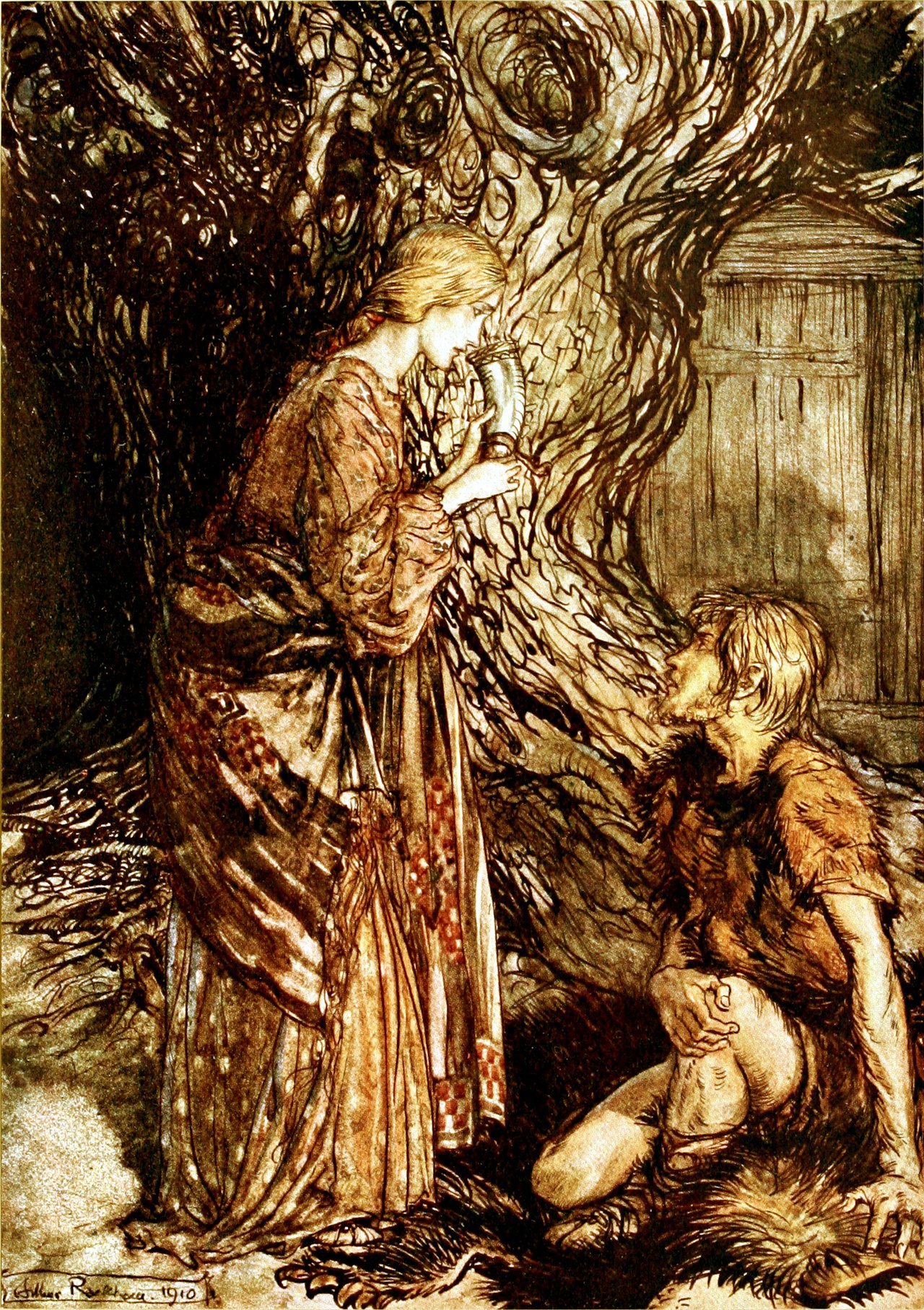
in scene 1, when Siegmund asks Sieglinde who she is,[2]
Wagner writes: Sieglinde wants to give him an honest answer, but thinks
better of it. After she begs Siegmund not to leave her, for she, too is in
distress[3],
the instructions read as follows: Sieglinde is shaken by her own confession
to the depths of her being. Siegmund stops in his tracks, deeply shocked: he
looks searchingly at Sieglinde’s face; she lowers her eyes in shame and
sadness. (emphasis mine.)
Even though Sieglinde has revealed almost
nothing directly to Siegmund through diagetic speech, the contours of her situation
vis a vis her husband Hunding are already well defined by way of these
non-verbal cues. Firstly, Sieglinde is wed to a man whose control over her is
so powerful it triggers within her a strong reflex of both deference and
anxiety even when he isn’t there. (This is of course augmented by the text –
lines 28-31 - in which she declares herself to be Hunding’s property.) Second, hers
is a situation, the stark reality and emotional trauma of which has been so
repressed by her for so long and perhaps so hopelessly (hence the urgency),
that to even speak of it leaves her in a state of extreme emotional distress.
Third, that the nature of this relationship is shameful belies a sexual
connotation.
But this scene is an intensely private moment. In scene 2, when Hunding returns, Sieglinde’s now public behavior, in part because the social situation requires a certain amount of wifely tact and in part because she is not facing her husband alone, is very different. As is the case with many women whose husbands abuse them, for her, the avoidance of conflict -- and, when inevitably faced with it, a resultant and necessary private resilience -- is the basic condition of everyday life. This tension between appeasement and dignity, reinforced by the decorum required by Sieglinde’s class position, is apparent the second Hunding enters the room. When he immediately interrogates her about the presence of another man in the house, Wagner describes Sieglinde as calm, speaking neither quickly nor unnaturally. Similarly, when Hunding makes his insinuation that his wife is listening to her guest far too eagerly, Wagner directs her to be relaxed and involved.
The longer Siegmund remains with her, however, and the more he elaborates on his story, which she undeniably finds sympathetic, the more emboldened Sieglinde becomes, and the more she begins to push the boundaries of her status, including in speech. This is best seen in the moment when Hunding, after hearing more of Siegmund’s tale tells him “the man, you, stranger ask for shelter / is not happy to greet you as a guest” to which Sieglinde responds (livening up somewhat with a voice of faint disdain) “A lonely, defenseless traveler / instills fear only in cowards.”[4] These are not the mannerisms nor the behavior of a passive woman.
Just as Siegmund’s weaponlessness is critical to Sieglinde’s initial receptiveness to him (both in general and erotically) in the opening scene, both it and his anonymity are social conditions Sieglinde can cleverly weaponize against her husband. (This is part of why she is able to remain so calm.) That Siegmund has been stripped of his weapons ironically protects him better by way of the feudal system of honor than any actual weapon ever could, because, should he be armed, the tension between competing masculinities would become untenable. Put simply, Sieglinde essentially outwits Hunding by putting him in a double social bind: he can’t hurt Siegmund because the code of manly honor requires the sheltering of the vulnerable, and he can’t hurt his wife either because they are in the presence of a guest.
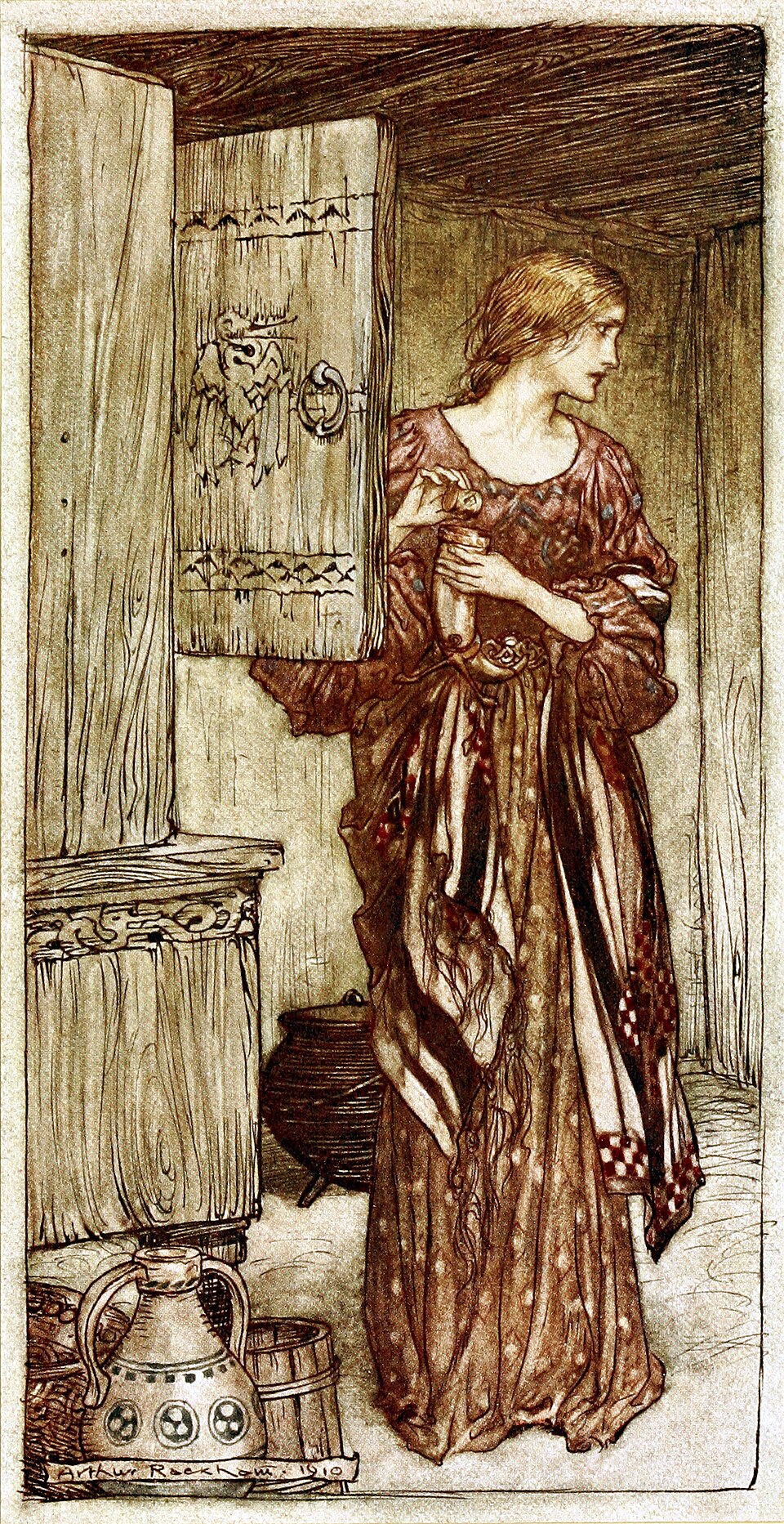
Of course, as will soon be made clear by way of Siegmund’s second testimony about his rescuing the young girl from being married against her will, in which he not only establishes his divergent value of a woman’s life over the honor of men but unwittingly reveals himself to be the perpetrator of the crime Hunding has spent all day fruitlessly trying to avenge -- Siegmund isn’t as innocent as he seems. After this fateful revelation, the delicate social balance so carefully orchestrated by Sieglinde comes crashing down, allowing Hunding’s growing feelings of emasculation to finally find a suitable outlet, not only by way of his claim against Siegmund’s life, but in the reestablishment of his social and sexual control over Sieglinde, the latter of which is communicated through his thinly veiled threat of sexual violence: “Get out of the room / don’t hang around here; / get my drink ready for the night / and wait for me to come to bed.”By this point, as we can see in her silent attempts to redirect his gaze away from her and towards the sword in the tree, Sieglinde clearly realizes that Siegmund, owing to his political solidarity with women, is the only person willing to facilitate her escape for reasons other other than manly self-interest. As such, she commits an act that is justifiably moral, which is to lace her husband’s drink with a sleeping powder, the existence of which, by way of the subtextual implications of Sieglinde’s sexual subjugation, is rather sinister. This act of refusal, in which Sieglinde takes the tools of her own oppression and uses them against her oppressor should be seen as nothing less than a woman’s declaration of her right to physical autonomy, her refusal to be objectified, and, more explicitly and importantly, her refusal to be raped.[15] This makes it among the most courageous and heroic acts in the entire cycle committed by anyone, man or woman.
It also
touches on what is perhaps the key narrative fact of Sieglinde’s character,
which is that, throughout the opera, it is not Siegmund who saves Sieglinde,
but Sieglinde who saves herself -- and not only herself but her brother as
well. It is a sad reality of Die Walküre that Siegmund repeatedly fails
to save his sister. He may embolden Sieglinde’s own drive to turn her situation in her favor, but fails to spare her from her husband’s
wrath, the expression of which is a scene he has no choice but to witness
helplessly. His protection of Sieglinde via the magical sword Nothung, which is
not only a gift facilitated by her, but the very restoration of his own
masculinity, tragically does not last long. Even his love
for her cannot protect her from the toll of the past, a fear and grief Sieglinde ultimately seeks refuge from
in Siegmund not as her lover but as her brother[5],and
from which she so desperately flees and flees until fleeing is no longer
possible, situationally or emotionally.
II. Rape
This brings us to another crucial point. To speak of Sieglinde in any meaningful capacity is to speak also of trauma. Contrary to Götterdämmerung in which Brünnhilde's trauma - and her response to it - is played out in real time, much of Sieglinde's pain, including her death, transpires in the margins. (Indeed, one can say that she is quite literally marginalized.) These include first and foremost the gaps between Das Rheingold and Die Walküre and between the latter and Siegfried; the span between Act I and Act II in Walküreduring which Sieglinde is on the run with Siegmund, and the moment between Scene 4 and Scene 5 of Act II, during which she flees with Brünnhilde from the scene of Siegmund's death.Despite being mirrors of and equals to one another, the key distinguishing feature - and, really, the unbridgable chasm - between Sieglinde and her twin brother is the gendered nature of Sieglinde's pain, i.e. that it is the pain of sexual violence. The intimate nature of this pain is what makes it so difficult for her to openly articulate. This unspeakableness, rather than being mere 19th century propriety regarding topics of a sexual nature, is, in fact, a direct artistic choice by Wagner and should be acknowledged as such. Even Siegmund himself refers to Sieglinde's despair as "the fear that does not speak." But the way it does speak is through music.
One of the best musical examples of this elision of affect and meaning can be found in a brief passage from Act I, Scene 3, during which Sieglinde is telling Siegmund the story of her sham wedding to Hunding. Specifically, it is the moment she realizes the mysterious man in attendance is Wälse, her father. Through the leitmotif, Wagner develops a form of irony in which the music knows more than the characters, and so, when Sieglinde sings of the old man in wanderer’s garb who enters the wedding hall, the E-major “Walhall” (Valhalla) motif from Das Rheingold tells us that this must, in fact, be Wotan. But very soon this changes.
In between the musical patronymic and the revelation of the sword there is a passage of music just for Sieglinde herself. As she describes first the fear in the hearts of the other guests (Angst schuf es allen /traf die Männer / sein mächtiges Dräun) this E-flat opens big and wide into F-sharp minor, which itself passes searchingly and incompletely into D major like an excited gasp of recognition only to, in the next second, diminish, literally, into the small, sparsely orchestrated agony of the gaze between father and daughter.
But the mournful chromatic half-steps down to “süss schnenden Harm” (sweet, sorrowful joy) belong not to event itself but to the memory of it: they belong to the human being who has been recognized but to no end and for whom there is no answer to her suffering. All of it is sung in retrospect by the woman who must live with the fact that this man, her father, elected neither to fully reveal himself nor intervene directly in sparing her from devastation. All there really is, in the exchange of those half-steps, is the reality of one man passing her off to another, and this is a feeling that can only come through in music.
Even a handful of bars later when, accompanied by all the masculine bombast of horns, Sieglinde describes Wälse’s mighty thrust of the sword into the tree – this, too, becomes a moment of utterly unspeakable sadness. Suddenly the whole score is evacuated, the story continues, until finally the theme of the sword has, with the line “Keinen Zoll entwich er den Stamm” – not an inch it stirred from the tree -- rings stalwart and lonely out into the empty hall because for Sieglinde its arrival is not a moment of triumph but one of immense sorrow. Alone is the voice, almost from a distance, of the woman in white facing the terror of the bedroom door, for whom, in such a short span of time, both love and heroism have failed.
*
One of Wagner's most progressive choices in Die Walküre is his wholistic and sympathetic depiction of Sieglinde as a victim of rape. Not only does he openly equivocate arranged (i.e. forced) marriage with the stark reality of sexual coercion, he situates her rape within the systemic injustices - the feudal structures of honor and shame - that facilitate it. His refusal (contra his earlier work, Götterdämmerung) to both equivocate on the morals of the situation and to depict the rape itself, to instead make it a largely psychological affair, not only decenters the man involved, it insulates his character from a kind of secondary violation, that of the spectacle of violence and the subsequent albeit unintended libidinal gratification of the audience which is all too common in later depictions of rape in opera, such as the rape scene in Shostakovich's Lady Macbeth.
Sieglinde's remarkable final monologue to Siegmund, despite having been written over 150 years ago and by a man, no less, is and remains such a complete depiction of what rape does to the psyche, how it parasitizes sexual pleasure, how it sows doubt in the heart through shame, how it alienates one from one's own body, it retains, despite our more nuanced if fraught discourses on sexual violence, its original power. Here she says to her brother:
However, in lieu of a story of pity and revenge, Wagner chooses one in which the pursuit of compassion and personal freedom despite such devastation, and the belief, albeit imperfectly realized, in a kind of collective after - is indeed a heroism of its own. Even now, this is a profoundly radical choice. But one of the many tragedies of Die Walküre is that Siegmund, like most men in his situation, does not know how to respond to this outpouring of grief. In visible distress, he can only vow to destroy the evil man who has done this to her should he come after them. Only after Sieglinde is asleep and no longer able to hear him can Siegmund find the right words to convey what he really means, not only with regards to what Sieglinde has just revealed to him in her moment of agony, but his feelings for her as a whole -- that he understands the high stakes of their quest for another life, that he is thankful to have her by his side and can recognize the sacrifice she's made for him, but most of all, that the hero in him recognizes the heroine in her, and in this recognition, he is seemingly alone. He says to her tenderly, and not without anguish:
The larger tragedy, however, is this: In their final moments together, during his negotiations with Brünnhilde, Siegmund knows that he will die, and it is an act of humanity on his part to want to spare, by taking both their lives, his sister from the hell that awaits her without him. But even so, ultimately he will fail Sieglinde because, being asleep, she has no way to negotiate her own fate. Thus, and perhaps most wretchedly, Siegmund has replicated the very control over her he so sought to eradicate through love. It is difficult to say, when Siegmund falls to Hunding in battle, albeit through no fault of his own – whether this fate is any better than if Sieglinde had been felled by her own sword, the sword with which she saved herself. Siegmund’s death seals the inescapable horror of Sieglinde’s life in blood. And this, understandably, is why, before becoming aware that she is carring Siegmund’s child, she begs Brünnhilde to let her go as well. There will be no justice for her, and this, perhaps, is the worst part.
III. Cosmology
The death of the Wälsung twins is the great tragedy of the Ring, one from which Wotan and his world never recover. It is the point at which he truly relinquishes his control of his own fate. Suddenly, in its wake, there is no more fighting, with his wife, with his daughter, with Alberich. All that’s left is for him to go mad, wandering the world waiting to be relieved of the burden of power on behalf of his grandson, a man who is technically free but who never fully becomes himself.
But, beyond
the obviously gendered ways in which both twins die, and beyond even the
sacrificial birth of Siegfried, the structural role Sieglinde plays in the Ring
is different than her brother’s. It can be said that Siegmund may be the
impetus, but Sieglinde is the map in that Sieglinde’s death, and by extension her
life, reveal a hidden function in the Ring’s structural cosmology,
its systems of pulleys and levers, its total set of constellations.
This death,
which takes place in the unwritten interregnum between Die Walküre and Siegfried
and which is only mentioned in a passing remark Mime makes to an insistent
Siegfried, marks the true middle of the cycle. If Siegmund and his fate is to
serve as the point of no return for Wotan, the moment in which the true end of
the cycle is set in motion, not only does Sieglinde factor into, or even
complete, this fate by way of Siegfried, she also contains – in fact, she interiorizes
within her own narrative -- the beginning, middle and end of the Ring.
This is a complex point to make, so much so that it serves as its own heterodox analysis of the Ring’s narrative totality. To put it simply: at its core, the Ring is a mirror world, one that is cyclical within itself. Many of the characters are in musical and narrative orbit with one another – Wotan and Alberich being the common example; Siegmund and Alberich, whose relationship is hinged on a key musical moment[6] and their joint rejection of the heavens in favor of hell, is another. And, of course Siegmund and Sieglinde are literally a mirror, or perhaps one could say the inverse, of one another.
But only Sieglinde is a prism through which the whole cycle passes through like a beam of light. Like the Rhinemaidens in Das Rheingold, a magical object is entrusted to her whose disturbance alters the course of the world. Like Freia the fair, she is abducted and forced into a bond with a monstrous man (in Freia’s case, two of them – the giants.) Like her brother, she is disenfranchised, unfree in her own freedom. One can even go so far as to say that Sieglinde shares a distant, yet structurally important commonality with Erda, in that she, too, is a primordial mother to a new world order.[7]
Indeed, Sieglinde’s lurid visions of the ash tree snapping in the last scene of the second act function as both foreshadowing (perhaps even clairvoyance) and thematic bond. In the Ring, the symbolism of the ash tree itself forms a unique dialectical pivot, one of divine intervention and agency with disasterous consequences. Should Wotan have left the World Ash Tree untouched, instead of cutting from it his spear of contracts, there would have been no logical precedent by which Alberich could have, through his theft of the gold from the Rhine, violated the natural order in his own world-altering way. Should Wotan have spared Sieglinde from serving as bait for his son via a magical object that has irrevocably wounded an ash tree of a different kind -- should he never have created the conditions by which the two could have only possibly loved each other, the forming of the incestuous bond through which Fricka is able coerce Wotan into killing his own son would never have formed and the world may have turned out differently.
Most
consequential, however, is the dyad formed between Sieglinde and her
half-sister, Brünnhilde. This is most musically evident in the much-remarked upon use of the Assurance ("Redemption through Love") motif, which is sung only twice, when Sieglinde hears the news that she is carrying Siegfried in her womb ("O hehrstes wunder!") and during Brünnhilde's final immolation in Götterdämmerung. Indeed,
Sieglinde is, in many ways, a curse on her sister, one that's just as powerful as the curse Siegmund leaves on
Wotan. It damns Brünnhilde to an ideal, a desire to live her life in her
sister’s image, an image Brünnhilde goes to extreme lengths to replicate in her
passion for Siegfried. Even her conditions at the end of Die Walküre are structured in this way. Like Sieglinde, Brünnhilde's own father threatens to submit her
to the humiliation of a Sieglinde-like possession at the hands of whoever finds
her lying helplessly on the fell, only for Brünnhilde to later negotiate a
similarly Sieglinde-like situation in which she lies in wait, simultaneously
conscious- and unconsciously[8]
to be rescued by a Wälsung with a magic sword.
But not only does she wait for him to rescue her, for him to bring
her the sword, like the twins, Siegfried and Brünnhilde must also recognize via the sexual act that they are fated
reflections of one another, not only by way of a preordained (albeit orchestrated) incestuous bond,
but through the foreshadowing bind of loving death which, at the end of Siegfried is lauded by both of them in a
loud, final chorus of two. Such Wälsung hauntology
even materializes in the fact that the thought of Sieglinde overcomes her son in his most
intimate moments, such as when he searches himself for, but never fully discovers,
his own identity, or most astoundingly, when he is about to make love to
Brünnhilde for the first time. There exist so many discrete signs throughout the cycle that what was fated for the first generation is fated for the second too, a development that reaches its ultimate musical expression in the grand motivic spread of the Funeral March.
But these images of Siegfried and Brünnhilde are fractured, by time, by knowledge, by the uneven bond of a kinship which does not share the mystical power and symbolic significance of twinness, and, of course, by the greater curse, which has returned from its long slumber in full force: the curse of the ring. Thus, it is like Sieglinde, that Brünnhilde -- albeit symbolically via the recapture of the ring and thereby the theft of what little power she has left – is also raped. That this is perpetrated by Siegfried, the man she loves, a man who, in a horrible refraction of Wotan’s initial intentions for both his daughters, then captures Brünnhilde and proffers her to another in the slave bond of marriage, is an even greater tragedy. In the end, the real and final end, Brünnhilde, just like her sister, fulfills the same promise, dies with her lover for and on behalf of love. Across the course of the second half of the cycle, this mirror between sisters reflects infinitely unto itself until it shatters.
Thus, it is not enough to say that Sieglinde, after Wotan and Wotan’s own shadow, Alberich, is the most structurally important character in the Ring. The Ring is Sieglinde and Sieglinde is the Ring. This is because, in Sieglinde, one can find the first complete expression of the all-bond, the all-idea, the bond of violation that unites the cycle from beginning to end, the bond which, for its women and for its allegorical woman, the earth, is the bond of rape. Even Siegmund, who dies in an explicit act of penetration and whose sense of self has been destroyed to such an extent he forgets or represses his own name, and Siegfried, who, in a horrible mirror of his mother's plight, is coerced by way of the magic potion in Götterdämmerung into the dual state of both victim and perpetrator fall along this same spectrum of violation, of the stripping, through humiliation, of personhood.
These
mirrors, these symbolic fractals are endless. The more I look, the more I find
them everywhere. As much as Sieglinde haunts the Ring, she has haunted
me as well. Across the year and a half it’s taken for this analysis to fully
materialize, I have ricocheted back and forth throughout Sieglinde’s life with
the firm, yet still admittedly obscure belief that she, more than anyone else, is
the keystone compressing together the arch of the Ring. This is the arch that spans the ground that
is Das Rheingold and the lurid dreamworld counterpoint it finds in Siegfried, a span
that finds in its neighbor the existential constructs of Die Walküre and their deformed and variegated manifestations in Götterdämmerung.
Only Sieglinde, given the completeness of her narrative and her temporal position at the point of refraction within the cycle, holds this mirror world together.
Whenever I think of
her, which is often, I am always reminded of the passage from the third scene where she sings to
her brother:
and now I see it again;
then it rose up from the water,
now my likeness comes from you![9]
So it was, and so it shall be, for these are the same waters from which the Rhinegold was dredged, and, downstream of the Rhine, the waters that will extinguish the great fire that incinerated the world. But perhaps even more important to our discussion, and to the spirit of Sieglinde herself, are the words – plain, rather than obscure – by which this woman, who is both extraordinary and yet as ordinary as the day is long, expresses the hope and the desire shared among all who suffer:
I’ll go after
all I ever lost,
all I ever mourned
I’ll win again;[10]
It’s a kept promise. One only wishes it were kept differently.