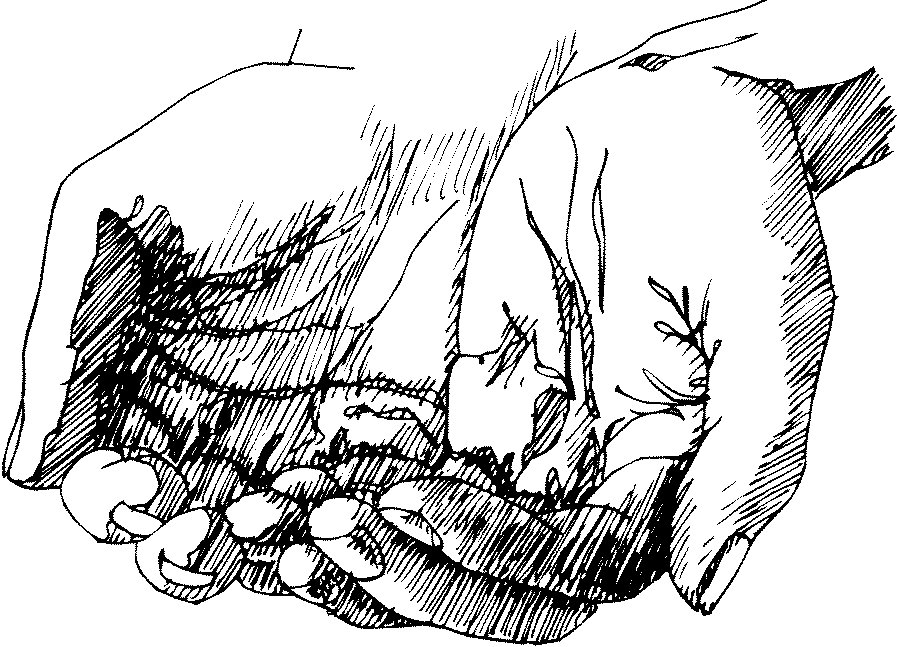
Siegmund, parting his hair with his wet fingers, sitting naked before a shallow brook. He watches himself quiver in the water, rests his hands, cut up on the knuckles like always, on the plain of his stomach, which is soft and tender to the touch. Though it usually makes him sad, when the evening is particularly pleasant and forgiving, he sometimes thinks of what it would be like to have a warm, loving face resting in those hands, or against the soft of his belly, right beneath the woeful protruding of his ribs. How readily his hands would brush back that face's hair, would trace the outline of her ear, would pull her back into his arms so that her warmth could be closer to him than ever – if only he could find her!
Alas, this woman, he has no face for. In his mind's eye, he sees only scraps and fragments of her. The face is unimaginable to him; to create it, he believes, would be a form of lying to himself, or of setting himself up for hopelessness. And so, whenever he gives in to his imagination and pictures making love to her, he calls to his aid the fluttering orange fields of his eyelids, backlit by the sun. This, to him, is the greatest approximation of what the tumultuous burying of his face in her neck or her hair or her breasts might look like — everything a lush, corporeal pageant of shifting light.
A great deal of effort goes into perpetuating this illusion, contortions of his body, compassionate acts. Despite his embarrassment, sometimes this daydreaming really does feel close to something. Sometimes, when his arms so encircle himself, clutch him closer to himself; when he turns to nuzzle the top of his arm where it meets his shoulder — when his hands hold his face, when he fills his hair with his fingers — he is taken for a moment out of the world, and into a new pocket of existence, where he briefly becomes for himself both self and other.
Yet this other-self that loves him is timorous. She speaks to him in a whisper so as to not sound too much like his own voice. What he says to himself through her is not repeatable even to him. He wishes he had a name to whisper, but because he does not, he makes do with whispering his own name as though someone else has said it. The name she whispers is his real name, the name no one has spoken to him since his father vanished, and when he hears it, he rakes his nails across the high span of his back until it is as though someone is clinging to him so closely, he can barely breathe. Within his own breath, faintly he can perceive the little hitched inhale of hers.
Tightly he presses into the hand that feels less like his, his hair damp with sweat. There are no words where he is now, only the body giving way to itself. On his knees, he muffles his voice in the crook of his arm even though no one is around to hear him. No one is there to see his reflection contort in the still water as he soils his hand and spills onto the unsuspecting earth. Owing to his godlessness, as he does, he beckons for love, and this and the truth of his solitude sadden him, make him hold onto the vision until it is no longer possible. His body has stilled and with its stilling so returns the rest of the world. He uses his final moments of enthrallment to kiss away the seed from his fingers.
After, one kind of trembling is exchanged for another, the whistling wind, which ripples through the whole gully. Closing his eyes once more, he loses himself for a moment in sorrow. It always amazes him, how close it feels, how time and space can disappear within himself, how he can transport oneself to another world where there is someone waiting. How, he wonders, can a body be beyond itself, can it seem as though it is sharing itself with another from afar by way of nothing more than his own will? It is so easy for him to see in his own hands a woman's hands, in his own mouth a woman's mouth. Always, in his lapses in concentration, he loses her. Yet sometimes, when he watches his own face unravel, it's as though he can see the faintest glimmer of hers in it.
Return to Index