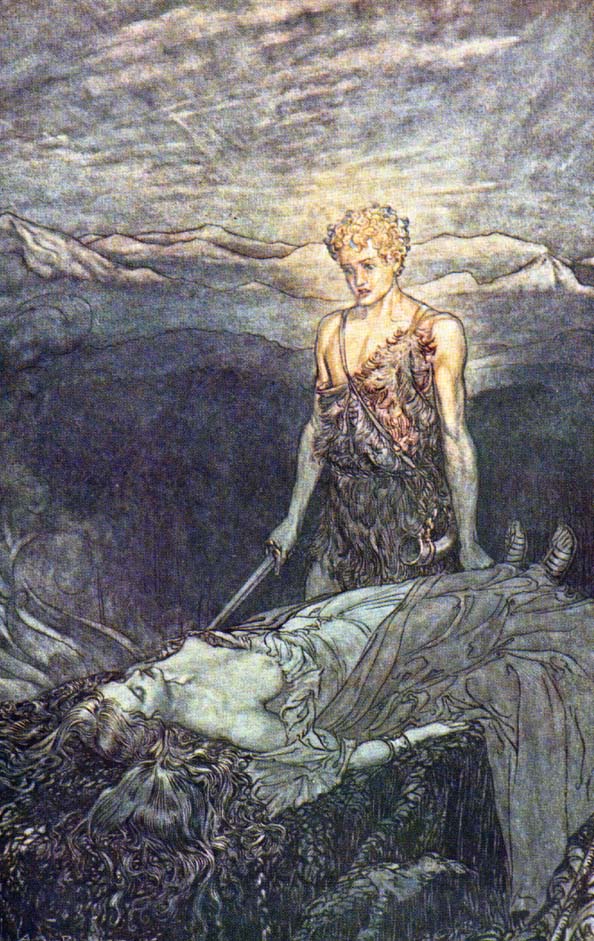
In most guides and discourses on the Ring, the topic of Brünnhilde's incest with Siegfried, while factually true, is almost never discussed in a critical way. Part of this is because the overt and romanticized incestuousness of the Wälsungs takes up all the air in the room; the other part is that this incest is never elaborated upon by Wagner in Siegfried and Götterdämmerung themselves. Thus, most are of the opinion that the fact Brünnhilde is Siegfried's parents' half-sister is not particularly relevant and that, instead, it is best to simply see the pair as star-crossed lovers, as man and woman in lateral, rather than vertical, relations with one another. Unfortunately, however, a closer read will tell us this is not the case.
As discussed in a prior essay about incest in Die Walküre, the fundamental organizing quality of all incestuous bonds is that they are simultaneously self-affirming — they involve the narcissistic desire for the one who is like oneself — and self-annihilating in that by loving the one who is like or who is even a part of oneself, one denies that person the right to their own self-differentiation: the ability, through one's separateness from others to become oneself. To bring the person who is like oneself into the bond of love is by definition deleterious — it destroys both parties and leaves very little left, because both forms of love — familial and romantic — become unrecoverable.
That being said, there remains a major difference — both emotionally and politically — between Wagner's two consanguineous bonds. In Die Walküre, the sentimentally incestuous bond between Siegmund and Sieglinde is also a philosophical exploration (albeit ultimately failed) of the potential for true parity between men and women as rendered through a love in which both parties are the same. Their love is utopian in scope and its foundation is the bond of solidarity: I suffer as you suffer. This is what has allowed their incestuousness to be broadly accepted despite its brazenness.
However, even though this love is genuine and true, the tension between self-affirmation and self-negation still inevitably resolves in tragedy. Siegmund speaks when he pulls the sword Nothung out of the tree of the inevitability of death. Sieglinde, in the throes of her crisis, is unable to reconcile Siegmund her brother with Siegmund her lover. In his attempt to take both their lives during his negotiations with Brünnhilde while Sieglinde is sleeping, Siegmund denies, in classical incestuous presentation, Sieglinde the opportunity to choose her own fate. At least, however, they tried, and, as we will see, this trying to resolve the contradiction of incest, which manifests narratively as a tragic pursuit of true love, has a life-altering psychosexual impact on the woman, Brünnhilde, who bears witness to it firsthand and intervenes on its behalf.
Unlike with the twins, however, the love between Siegfried and Brünnhilde has no such philosophical basis, and not only because there is no semblance of gender parity to begin with (outright Siegfried is presented in the typically masculine mode and Brünnhilde, now stripped of her Valkyrie powers, in the typically feminine one.)
This presentation is deceptive, however. Despite what appear to be traditional gender roles, the love between the two actually begins and ends with a profoundly unequal power relation, one in which Brünnhilde, having orchestrated Siegfried's entire fate — from his finding her on the rock to his untimely end — has the upper hand. As a result, the incestuous balance between self-affirmation and self-annihilation is firmly tilted towards the latter. We can see this across the board — in the similar celebration as Siegmund's of love-in-death, in the knowledge Brünnhilde deliberately withholds from her lover, and, most tragically, her entitlement over his right to life. It is, in this way, traditionally rather than sentimentally incestuous. Its outcome is disastrous.
*
Brünnhilde's desire for Siegfried begins, famously, before he is even born. This is because, underlying all of Brünnhilde's relations with Siegfried, are her previous ambiguously romantic feelings for her half-brother Siegmund. Wagner does not elaborate on this in full, but presumably, Brünnhilde has been watching Siegmund from the fortress of Valhalla for quite some time. We know she has already watched him endure terrible hardship, has watched as he has repeatedly defended a woman's right to life over that of a man's honor, has seen the full brunt of his deep sensitivity and empathy for others.
Siegmund's desperate and tragic end alters the course of Brünnhilde's life forever. His love for Sieglinde becomes something that so moves her, she is willing to risk her own life on behalf of it, an act that is punished by Wotan in the form of explicit patriarchal violence. This battle between father and daughter has broader and arguably feminist implications through Brünnhilde's rejection of a patriarchy in which she was previously complicit at the cost of her own bodily autonomy, though this is not the place for further discussion of them. (Brünnhilde, more than any other character, is a political mixed bag.)
In the last act of Die Walküre, we can see in Brünnhilde's defense of her actions to her father, the undercurrent of Siegmund's erotic hold on her. When Wotan (albeit for the wrong reasons, i.e. to juxtapose the pain of killing his son with Brünnhilde's seemingly frivolous defense of the latter's romance) accuses his daughter of "...gaily extract[ing] / from the fountain of love / the wanton frenzy / of erotic feeling" he's not entirely wrong. Just a few lines earlier Brünnhilde speaks of Siegmund thusly:
BRÜNNHILDE:
I had to see Siegmund...
[I] noticed his eyes,
heard his words,
the hero's sacred peril
came home to me;
the lamentation of the bravest
resounded in my ears:
the grim suffering
of the freest love;
the fiercest defiance
of the gloomiest spirit!
My ears were ringing,
my eyes seeing
all that shook me to the core.
my heart pounding heavenwards!
Apprehensive and amazed,
I stood so ashamed:
just to serve him
was all I could think;
Wotan later responds by saying: "You joyfully pursued / the allure of love; / so follow him [Siegmund] / if love him you must!"
It is after this moment that Brünnhilde negotiates with her father the humiliating fate he has in store for her as punishment: that she be put to sleep and left at the mercy of whatever man should find her on the fell. In her desire to be found by Siegfried, Brünnhilde goes to extreme lengths to replicate the relations Siegmund has with Sieglinde — that there is a Wälsung braver than any man, that he wins for himself a magic sword, that he uses that sword in the protection and pursuit of a woman. (For more on Brünnhilde and Sieglinde as mirrored pairs, see: Sieglinde as Heroine.)
There is, of course, an irony at play here, which is that despite her ostensible quest for freedom through love, Brünnhilde is far more involved in the fate of another than Wotan ever was with Siegmund. This over-involvement, which is, in reality, the true completion of her father's project (both of securing the ring and, failing that, ending the world) has tragic consequences for both of them. Brünnhilde's banishment of Sieglinde to Neidhöhle, albeit in part because her father is forbidden by his contract with Fafner from going there himself1, essentially condemns Siegfried to the world of Das Rheingold, to the world of the curse.
This is to prevent a repetition of the Siegmund problem in which, as a free man, Siegmund directs his life towards his own ends which have nothing to do with the project of the ring. What is so terrible about Siegfried's situation is that, through his killing of Siegmund, Wotan has already rescinded his control over humanity — in the world Siegfried is born into, man is already free.2 But because he is born into the world of the curse and is brought into its story through his contact with Mime, this universal freedom is already occluded.3
In her pursuit of Siegfried, Brünnhilde is doubly incestuous, not only because the beneath all this is, of course, the feeling that if Brünnhilde can't have Siegmund, his son will suffice, but that, by engineering the entire course of his life precisely so that it will lead directly to her, Brünnhilde is fundamentally denying Siegfried his right to differentiation, to free subjectivity, in short, his right to become himself.
This incestuous drive is remarkably vertical. In adopting what is effectively the positionality of Siegfried's mother through making the decision of how he will grow up to be, Brünnhilde is ensuring that he will never become separate from her.4 In Siegfried, she essentially tells him all of this herself:
Oh, if you, the world's pleasure,
knew how I always loved you!
You were my mind,
my only care.
I fostered your delicate being,
even before you were conceived.
Even before you were born,
my shield was your shelter.
like a mother speaking to her child
I've loved you, Siegfried, that long!
The great tragedy of this lies in how Siegfried responds to this and how Brünnhilde responds to him in kind:
SIEGFRIED softly and shyly:
So my mother didn't die?
Was my love just asleep?
BRÜNNHILDE:
You sweet child!
hesitantly
You'll not see your mother return.
I am you, your very being,
with warmth
if I am the blessed woman you love.
restoring her calm
What you do not know,
I know in your stead;
yet I know
only because I love you!
This is not only an unambiguous depiction of the aforementioned vertical incestuous drive — to control another's fate because they are, as she says, one's own very being, (including the overt allusion to Brünnhilde's motherly role) — it also demonstrates a further element of direct control she has taken over Siegfried's life: her deliberate withholding of knowledge from him.
Siegfried knows nothing of his parentage or of the world responsible for his own coming into being. He asks Mime about his parents, about whom Mime reveals only their names, because keeping Siegfried ignorant is part of his ulterior motive vis a vis the plot to recapture the ring.
What is astonishing however, is that Brünnhilde, who knows everything imaginable about him, also keeps this knowledge from him. This, more than any other choice made by her, is instrumental in keeping Siegfried from self-actualization. Brünnhilde's "hesitancy" is for an obvious reason: should Siegfried figure out who she is, that she's related to him, that she had a hand in his parents' deaths, perhaps he wouldn't be so easy to seduce.
One of the more uncomfortable truths of the Ring is that in Siegfried, Siegfried is essentially a child. Even in the above excerpt, when he is supposed to be approaching manhood, Brünnhilde addresses him as a child. This makes her seduction of him (for this viewer at least) extremely uncomfortable, even though Wagner, by keeping her young and virginal tries to create some degree of parity within the bond of seduction. This is something which Brünnhilde acutely feels herself — her back and forth about making love with Siegfried is also predicated on the fact that should he take her, she would lose what little power she has left.
But Siegfried, when confronted with the sexual act is expressly frightened by it. Incredibly, he calls out, even, for his own mother to intervene. This fear is completely understandable, not only because the physical enjoinment of self and other, an act of total vulnerability is one for which he is not ready (in part because he has no self to so entwine) but also because Siegfried is, unlike Brünnhilde, completely unsocialized in any way whatsoever.
We can recall here Siegfried's questioning of the mating of the animals in the forest and whether or not such a thing is how he himself was begotten. Prior to reaching the woman on the rock, Siegfried has had no contact at all with womankind, has no knowledge of the social norms between human beings, is ignorant, even, of the existence of romance itself, along with friendship, solidarity, or any sense of justice. His drives are completely unarticulated, as evidenced by the fact that he is, up until he is confronted with erotic possibility — incapable of feeling fear. From beginning to end, he is best seen an empirical subject who learns only by what he senses.
Eventually, this will come to bother Brünnhilde, as well. That Siegfried is not like Siegmund — that he is not a hero with a specific motive, that there is no difficulty to overcome in their relationship together, that he really does need nothing beyond her because he has no clear organizing motive in his life — this is the impetus behind her drive to send him to earth to do heroic deeds.
In her prior orchestration of Siegfried's fate, Brünnhilde has forgotten what made Siegmund Siegmund to begin with: a social system — a deeply inequitable one. This inequity was the fire in which Siegmund's sense of right and wrong was forged. It was a world requiring that which does so much to shape the personal development of human beings: suffering, and by extension, both the fortitude to endure it and the bravery to fight against it. Siegfried's world has no such society, not only because he grows up in the isolation of the forest but because the gods, the shapers of that society, have since abdicated their interference in human affairs. This naivety renders him both a directionless but more importantly an apolitical subject.
Because Brünnhilde seemingly still cannot reveal to Siegfried what she knows about him, she believes that simply having him experience hardship will do the work for her. There is also in her words to him a profound insecurity about what she has to offer Siegfried now that she's abnegated her own powers through her enjoinment with him ("do not despise / this poor creature...who just wants to give / but can give you no more.") Siegfried, maybe even to her horror, answers with "Yet one thing I do know and cherish / that Brünnhilde lives for me; / that lesson I easily learnt / to think of Brünnhilde!" Lest he get caught up further in this passion, she invokes his prior heroism regarding the dragon and the fire he had to pass through. After all, it's the only strife he's had to endure even if it is only bravery for bravery's sake.
This sending Siegfried down to earth is a fatal error on Brünnhilde's part, and it's a double error on behalf of her incestuous drives of control. Siegfried, because he is not inoculated against the wiles of the human world, immediately succumbs to guile and becomes a victim of objectification and seduction by way of Hagen's love potion. The crime he commits against Brünnhilde, despite being a terrible act of gendered violence, is never fully his crime. Before he can come to and realize what has happened, Brünnhilde takes Siegfried's fate into her own hands and ends the life she herself functionally began. She does this because it is what she has always done.
Having only ever been a pawn in other people's desires, namely, those related to the ring, but also the sexual desires of both Brünnhilde and Gutrune, Siegfried is, like his father, an alienated and oppressed subject who, despite his manly strength and total freedom, will incur tremendous violence at the hands of the unfree. But unlike his father, the tragedy of Siegfried is that he does not know nor understand this about himself. About himself he knows nor understands nothing at all.
All in all, when Siegmund and Sieglinde succumb to their desire for one another, it is, despite its incestuousness, a victimless crime. (In truth, they are both made victims by Wotan, the one who brought them into the world.) Siegfried, however, is thoroughly a victim of incest in the most traditional understanding of what that means. He is a victim of this before he becomes a victim of the atavistic world against which he was supposed to sharpen the blade of his own heroism. Without one, there would not be the other. What could have happened in its stead is unknowable, but it probably wouldn't have involved the woman on the fell. In the end, what this reveals about Brünnhilde is exactly the same thing Siegmund reveals about her father: that when it comes to those below, those above, despite their protestations to the contrary, view freedom as something conditional, something that can be created at will and destroyed by force. We can call this a lot of things, but we can't call it love.