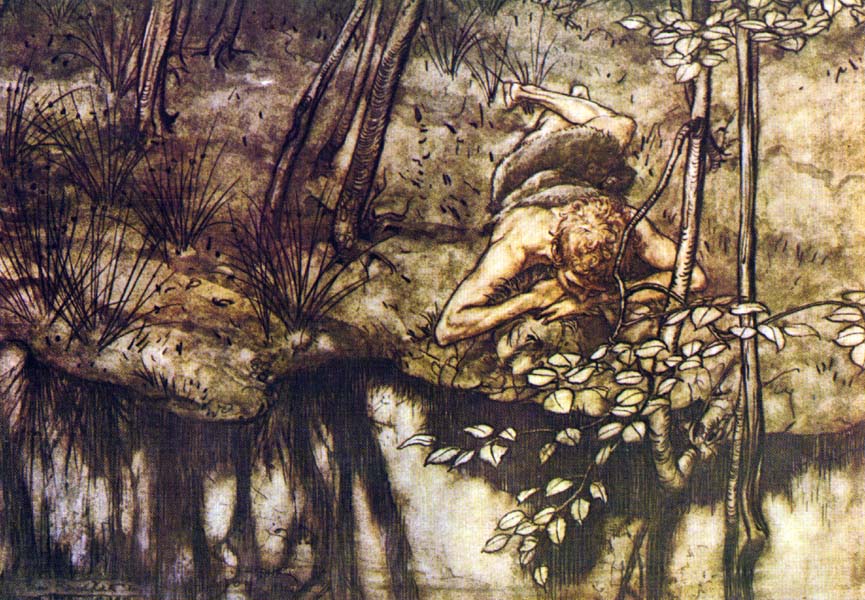
I think Siegfried is a hole one can disappear down forever. I really do. This sentiment remains the same regardless of which Siegfried one is talking about, and there are so very many. It could be Wagner's, it could be Fritz Lang's, it could be Sigurd from any of the Norse sagas, or Sivrit from the Nibelungenlied. They are all different. They are not different at all. In the beginning, every Siegfried is made from the same basic ingredients: beauty, strength, and bravery. One cannot help but feel a certain helplessness knowing that none of these exceptional attributes will come to his rescue.
There's considerable variation in how Siegfried begins his life, but once it's begun, he proceeds, seemingly propelled by some vague momentum, through the same discrete set of events. He forges the same sword, slays the same dragon, secures the same treasure, makes the same pact with the same coward, commits the same crime against the same strong woman, dies the same death, over and over again throughout the centuries. Each time a Siegfried is created, his only purpose is to become ensnared.
The most basic substance of Siegfried is this: something powerful and free comes into the world; then, through a complex mechanism of social or contractual entanglement, it must be destroyed. This destruction is not cautionary in nature. It warns of nothing, moralizes nothing. It is not a parable of arrogance or an encouragement to eschew the wiles of women or choose one's company wisely. It is simply a series of events that cannot be otherwise.
Hence, a set of crucial questions come included with each iteration: how can a man who is, as they say, beautiful, strong, and brave, do what he does, end up in his same situation? Why does he entrust himself to a weak man such as Gunther? Why does he do the dirty work of a coward by capturing and subduing the woman said coward is not strong enough to woo himself?
If Siegfried is so honorable, why is he willing to lie, cheat, and steal with little to no reflection? How can he not see that the pact he's made with these kings is weaker than the bonds that hold together those kings as kinsmen? How can he be so naïve, from the first time he arrives in Worms (or wherever the myth is set) to going on that fated hunting trip? Each event Siegfried passes through only makes things more and more fraught. And yet, he trots from one moment to the next like a calf to slaughter, bereft of moral deliberation and an ability to discern guile from truth.
This guilelessness allegedly supports the idea that Siegfried is good. He has to be good, otherwise why would 800+ years' worth of Scandinavians and Germans mourn him? And yet, at the end of the day, despite his goodness, he does a terrible thing. Even in its most benign form, such as in the Völsunga saga, where Siegfried, disguised as Gunther, breaks through Brunhild's wall of flames so that the real Gunther can come abduct her, this act is terrible. Once Brunhild refuses to let Gunther take her to bed, Siegfried's behavior only becomes more terrible from there.1 Either disguised as Gunther via the Tarnhelm or otherwise concealed by the dark, sometimes Siegfried is implied to have raped Brunhild (as in the Thidrikssaga).
Other times, he brings her within an inch of her life so that the real Gunther can reap the benefits of her broken spirit. The Nibelungenlied — which differs from the other texts mentioned here because it filters the same characters and events through the social structures and patterns of signification endemic to courtly life in the High Middle Ages — serves as a middle ground between the mere quelling of the fire and implicit rape. It describes the act as thus:
"[Brunhild] locked [Siegfried] in her arms and would have laid him in bonds like the King [Gunther], so that she might have the comfort of her bed. She took a tremendous revenge on him for having ruffled her clothes. What could his huge strength avail him? She showed him that her might was the greater, for she carried him with an irresistible force and rammed him between the wall and a coffer.
'Alas,' thought the hero, 'if I now lose my life to a girl, the whole sex will grow uppish with their husbands for ever after, though they would otherwise never behave so.'
The King heard it all and was afraid for the man; but Siegfried was deeply ashamed and began to lose his temper, so that he fought back with huge strength and closed with Brunhild desperately. To the King it seemed an age before Siegfried overcame her. She gripped his hands so powerfully that the blood spurted from his nails and he was in agony; but it was not long before he forced the arrogant girl to recant the monstrous resolve which she had voiced the night before...[Siegfried] now crushed her on the bed so violently that she shrieked aloud, such pain did his might inflict on her. Then she groped for the girdle of silk round her waist with intent to bind him, but his hand fought off her attempt so fiercely that her joints cracked all over her body! This settled the issue, and she submitted to Gunther."2
Morally ambiguous even in its time, the contemporary reader is certainly disturbed by such a graphic depiction of gendered violence, despite the poet's insistence, a few lines later, that Brunhild "happily" agrees to become Gunther's wife. Such violation gives us pause, makes us wonder whether Siegfried deserves it, that self-same fate. Maybe — probably — he does. In a story where many opportunities are provided for Siegfried to avert his end, the violation of Brunhild is always the final point of no return.
Then, when all is said and done, when the pike is in his back and his face is in the mud, we still ask: what happened? What happened to the Siegfried that slayed the dragon? What happened to the Siegfried that forged the sword, that left home and set about making his way in the world? How did he become this man? One can ask this question forever and not once walk away with an answer.
**
For the unfamiliar, beyond the violation of Brunhild, there are many variations in the Siegfried myth, too many to list in detail.3 Sometimes Siegfried is the courtly son of a queen and king (usually Sigmund); most other times, however, while his father is Sigmund (himself a more diverse myth than Siegfried), he is raised by a foster father who goes by various names (Mime, Regin, etc.) This foster father usually acts in bad faith for reasons of greed or envy and is later killed by Siegfried.
The child Siegfried is alternatively rude and impudent or precocious and perceptive. Sometimes he remains youthful his whole life; other times he grows into a hardened man, a warrior. When Siegfried kills the dragon, sometimes the dragon is the foster father's shapeshifting brother; other times it is simply a dragon. Sometimes he kills the dragon to prove he is brave or to win a treasure; other times his foster father sends Siegfried to do it hoping the boy will die. After Siegfried slays the dragon, bathing in its blood makes him invincible save for the spot on his back where, as the story goes, the linden leaf fell. In the Völsunga saga and the Prose Edda, Siegfried's strength is his own and consuming the dragon instead gives him the ability to understand the songs of birds.
The names and conventions of the people in whose trap Siegfried becomes ensnared are unique to each story, though for our sake it's easier to simply call them the Burgundians after the Nibelungenlied. Gunther (Gunner, etc.) is always a coward and cuckold. Hagen (Högni etc.), the fierce yet loyal vassal, is, with the exception of the Völsunga saga and the Prose Edda, the one to do the dirty deed of driving the pike through Siegfried's back as he goes to take a drink from the brook. Kriemhild (Gudrun, etc.) is always the wife whose love is collateral damage.
Brunhild, either a "queen" or a "Valkyrie" is always the supernaturally strong woman Siegfried must subdue, though her deceptiveness and whether each loves the other is a point of considerable variation. Whether Siegfried dies as vengeance for the wrong done against Brunhild or whether, in truth, he dies because the ruination of Gunther's honor cannot stand is also a matter of debate. And yet, despite these variations, one thing remains the same: Siegfried enters Brunhild's chambers and he will die because of it.
Some Siegfrieds, however, are easier to reckon with than others. Perhaps the easiest of them is "Sigurd Sven" in the Thidrikssaga, who is less a little princeling and more of a heat-seeking missile. Rude from birth, lustful for violence and glory, his temperament is of a mercenary nature. From cradle to dragon to ditch, he moves seamlessly from conflict to conflict, and when he dies, one gets the sense that it's because his luck eventually ran out.
Meanwhile, the Sigurd of the Völsunga saga is the most human, and perhaps this is why Wagner used this story (more than the Nibelungenlied) as the foundation for his own Siegfried. This is especially true with regards to Siegfried's love — and the later forgetting of that love via a potion — of Brünnhilde.
But crucial to this prior Sigurd is that both him and Brynhild know from the very beginning what will happen to the both of them. Brynhild because she possesses foresight and Sigurd because his fortune is told to him in his youth.4 Wizened, existing outside of everyone else by way of their knowledge, nothing can save them, not love, not brave deeds. When their great confrontation happens, they discuss their foiled romance openly. Sigurd says what is perhaps the saddest thing any Siegfried ever says:
"I love you more than myself, although I was the object of the deceit that cannot now be changed. Always when my mind was my own, it pained me that you were not my wife. But I bore it as well as I could since I lived in the king's hall. Yet I was happy that we were all together. It may be that what was earlier foretold will have to happen, but it shall not be feared."5
He tries everything to persuade Brynhild to regain the will to live, going so far as to pledge his treasure and ask for her hand in marriage, swearing to disavow Gudrun (Kriemhild) in exchange. However, to be together is impossible for many reasons beyond this strange determinism that binds them. The way things are in the world are cannot be otherwise. They know this to be true. And so, Sigurd partakes in the extraordinary sensation of grieving his death and the death of the woman he loves in the final days before it happens. All that's left is for the future to pull them listlessly along until the end arrives. This Sigurd, whose divergence from the others is by far the widest, is killed not in the forest, but in bed while he's sleeping.
When he gives his death-speech, he does so with a sense of acceptance, though part of him didn't quite believe it would all really happen the way it was ordained for him. Perhaps, more than any other Siegfried, his crime is lesser and we feel sorry when he dies.6 The foreknowledge present in the Völsunga saga makes explicit the crucial sense of inevitability common to all Siegfrieds and changes the sentiment of the character profoundly. Not only that, it articulates a nihilism lurking beneath its surface. If there is any lesson to be gleamed from him, Siegfried shows the futility of individualism in a world governed by systems, be they tribal, religious, feudalistic, or philosophical. Hence the myth's appeal for Wagner.
However, because Sigurd's critical self-awareness remained absent from Wagner's Siegfried, in its place is a murky affect that many such as Thomas Mann and M. Owen Lee (in his introductory book on the Ring) have compared to the id or some other subconscious drive. This is only accentuated by another choice Wagner made, which was to keep his Siegfried youthful, i.e. to make him of an age where his naivete and rude impulsivity are given a childish air as superego formation remains ongoing. Whereas the Norse Siegfrieds are forced to grow up quite young, Wagner's and that of the Nibelungenlied remain in a state of arrested development.
Indeed, much of the personality of the Ring's Siegfried comes from the latter poem's Sivrit, whose childish joie de vivre affords him arrogance and gives him a certain lightness. Often one gets the sense that, compared to the adults in the room, Sivrit is merely playing pretend and that his role as a courtly noble is largely helped along by the various trappings and customs of his time. Sivrit expresses himself in exclamation points; Gunther's answers terminate in calm periods. If we choose to view Sivrit as a protagonist, he can be read as a hero purer in intention and more free of constraints than the others (especially Hagen), who are quasi-cynical and hardened in their ways.
However, there is always a fine line between innocence and idiocy. Sivrit walks this boundary, but Wagner's Siegfried crosses it, often because the latter is not bound by those same elaborate courtly rituals that keep Sivrit's disposition and behavior in check. For example, when Sivrit enters Worms and immediately challenges Gunther to a fight for the possession of his kingdom, Gunther must talk him down through a combination of mutually recognizable flattery and manners. When the same scene is reproduced in Götterdämmerung, Siegfried is immediately subservient; naive, he uncouthly offers Gunther everything he has in the manner of a child.
Wagner's addition of Siegfried's rudeness towards Mime — ostensibly taken from Sigurd Sven, who beats up all of Mymmer's smithy boys, but, in reality, a convenient outlet for Wagner's antisemitism — is where rowdy boyishness starts looking more like ebullient ignorance, one tinged with now-uncomfortable nationalist and racial subtexts obviously missing from the medieval sagas.
Wagner's Siegfried, already trapped in the Siegfriedian bind, often approaches a total stuntedness. Not even sex — before which he cries like a Freudian parody for the comfort of his dead mother — can push him into something like a credulous adulthood. Patrice Chéreau was onto something in his 1978 Bayreuth staging when he had Siegfried enter the 20th century tuxedoed realm of the Gibichungs in quixotic armor. There is a certain ridiculousness to him as he exits the hard, primordial world of the Norse sagas and enters the formal political intrigue of the Nibelungenlied.
**
But these frictions are all part of another broader truth: every Siegfried contains within himself a contrary nature, dancing around the boundary of freedom and unfreedom. His is an anarchic and often violent life force that must then be channeled through external events which themselves almost always lead towards more violence. The degree of anarchism varies quite a bit, but it is present nonetheless.
It typically begins via that same childhood wildness and is thereafter reined in through courtly or warrior-culture socialization. In the poem, for example, the three kings and Hagen are shocked by Sivrit's unruliness and soon gleam that it is dangerous to leave Sivrit to his own devices. From the moment he arrives in Worms, their view is that it is better to control him than to fight him, for his is also a force they wish to use for their own ends.7
This need to bind something uncontrollable, to shape it and direct it as they wish will doom everyone, step by ugly step.
Bound or unbound by rules and conventions, Siegfried still bursts at his own seams. This is best typified in Wagner, who transformed Siegfried into a fantasy of a new man, a kind of Übermensch unencumbered by religion or bourgeois convention. In Siegfried, as a testament to such anarchistic splendor, he mocks Wotan, the father of battles, for standing in his way, calls him an old man, spurs him to fight. Little does Siegfried know that once he destroys Wotan's spear, law and lawlessness will become irreconcilable. All that remains in their place is pure, Siegfriedian atavism.
Sensuous and free as he may be, this Siegfried is nonetheless at the pessimistic mercy of the same bind, walks the same path towards annihilation. When these two seemingly conflicting elements — inevitability and anarchy — combine further with innocence, Siegfried as a character becomes more and more empty. Wagner's Siegfried is especially defined by lack — as being without fear, without remorse, without blame, without true motive, without compassion, without weakness, without logic or contemplation (sometimes, even, without brains!) — all of which are affectively different sentiments than being brave, remorseless, illogical, and so on. For example, bravery is something one must possess in spite of oneself. It is always easier to be a coward than it is to be brave. But Siegfried does not have to be brave because he has no fear.8
This results in a chilling uncanniness. Siegfried of the Ring is often unlikable and cold, despite Wagner's (frequently glorious) musical protestations to the contrary. He seems to lack a motive for doing anything, is merely guided by others or his id (let's say) from scene to scene. His cruelness to Mime, while supposed to signify a fundamental unruliness, mostly comes off as nasty. His loyalty to the Gibichungs is distorted into a nightmarish obsequience. He commits his deeds bereft of empathy. But even before he drinks the potion, it's there, that lack.
This is best seen when Siegfried is confronted with the total intimacy of the sexual act. Realizing he must give himself to another, he grasps at fear, that human emotion, only to forget it immediately in service to different drive: physical desire. Perhaps he simply possesses no self to give in the first place. The love Siegfried shares with Brünnhilde is not rooted in identification and mutual recognition of the self in the other, as was Siegmund's for Sieglinde, but is merely something else he has been told to do, something he has been led towards by strange forces.9
Thus, being rooted in no philosophy, it is, like Siegfried himself, also empty. There is something especially hollow about the way aunt and nephew sing (shout?) each other's praises, ending the opera with a lurid, brass-heavy conflation of desire with death. Rather like the scene in the Nibelungenlied when Sivrit sees Kriemhild for the first time and the narrator warns us how much grief will come of it, the end is always present.
**
Finally, Siegfried's actions make known the boundaries of his world, if not how that world works. Often he himself is a weakness in its very structure. This is true of all Siegfrieds but it is more true of some than others. A contemporary reader looking to whittle away the afternoon with the Nibelungenlied will walk away with the sense that, once Sivrit's spark catches in Worms, the poem's violence is like an inescapable fire that will engulf every single character. Even the most righteous among them will be made by the Situation to take up the mantle of that violence.
A fuguelike sensation grips us when rote and repetitive courtly language is invoked ad nauseum ("Mighty Gunther," etc.) to describe characters who, by deed alone, are or become terrible people. But as to the question of why, one would be wise to avoid reading more into the text than what it so clearly shows us itself. As Jan-Dirk Müller lays out in his monumental analysis of the poem, Rules for the Endgame, the situation of the Nibelungenlied spins out of control not because of some deep psychological intrigue, or because the Burgundians are bad and Sivrit is good, or Hagen is smart and Sivrit is stupid, but because of a hierarchy of feudal bonds that are irreconcilable with one another.
To summarize Müller's argument,10 Sivrit, a prince, enters the story almost completely unencumbered by political obligations, which is why he feels he has the agency to immediately upbraid Gunther on the basis of strength alone. This is threatening to the stability Gunther has formed in his kingdom through the now-established practice of peaceable hereditary lordship. Gunther brings the clearly much stronger Sivrit into his household through courtliness, forges a friendship that is first tested when Sivrit successfully fights the Danish kings on Gunther's behalf. Sivrit is unable to discern this, but when the pact is established to bring Brunhild to Worms in exchange for Kriemhild's hand, this blood-brotherhood with Gunther is simply weaker that Gunther's existing kinship ties and Hagen's ties to Gunther as his vassal. Its purpose is also fully served when everyone carries out their respective duties.
Hence, the introduction of Brunhild to Worms, combined with the terrible secret of how she was wooed, destabilizes all of these bonds in such a way that the weakest of them, which is still Sivrit's (now via marriage to Kriemhild) must be excised in order to bring honor and balance back to the feudal order.11 In the latter half of the poem, when Kriemhild exacts revenge on her brothers from the exile court of her second husband Etzel, the stubbornness of the bonds between the Burgundian kings and Hagen is such that all of them will perish rather than see those bonds be broken. Is this irrational to us? Perhaps. However, at the time, it was viewed not as a critique of the inherent absurdity of feudal logic but as a story of absolute fidelity that becomes heroic by the end. In fact, Hagen, the villain of the first half, is, by medieval standards, redeemed by the end of story.
More than any other element, the Nibelungenlied shares its sense of a world in helpless decline with the Ring cycle. In Götterdämmerung, Wagner took much of this same material and tried to diffuse it differently by integrating the machinations of the gods from the rest of the cycle, plot elements from the Völsunga saga, and the political sentiments of his day, which, while still sexist, were nowhere near medieval levels of misogyny. His Brünnhilde is no doubt a heroine, a woman given the full range of human emotion and tremendous depth of character. That being said, Wagner's loyalties still lie with men. He, like many later interpreters, will do what he can to somewhat forgive Siegfried of his crime.
If Lang's film adaptation attempts this more rotely by making Siegfried beautiful and sentimental and giving Brunhild an air of treachery, Wagner chooses a more complex method: tampering with agency. In Götterdämmerung, Siegfried's crime, rather than being committed as a simple favor of exchange for which he is rewarded with the possession of a woman, is instead stimulated by the forgetfulness potion. Wagner mixes this with a love potion to only further chip away at Siegfried's consent.
While this may certainly add succor to Siegfried's end, to me this muddying of the waters only further belies the truth that Siegfried still has no internal moral structure to give him pause. The potion does not make him forget himself, mind you, only Brünnhilde. Regardless of his scrambled motivations, he still commits the same crime in its own right, though his voice does, per the stage directions, waver when he enters Brünnhilde's fell. A common misogynistic fallacy is exposed by this choice of plot: that the love of a woman is the only barrier stopping a man from committing violence against her, and once that love has been shifted onto another subject, all bets are off. In other words, blame for the crime may be displaced, but it is not eradicated.
Of course, it is not the feudal system that gives Götterdämmerung its dreadful march towards the End, but a combination of mythical deterministic factors. Among these are the curse of the ring (in full force by the beginning of the fourth music drama), Siegfried's aforementioned shattering of the spear of contracts, and the foresight of Erda, who, in Das Rheingold, declared to Wotan the end of the gods, a fate he tried everything to avert before choosing, in Die Walküre, to embrace nihilism.
Many interpreters, including the likes of Nietzsche and Adorno, attribute this stark pessimism to Wagner's infatuation with Schopenhauer and his concept of the Wille: an inscrutable power that exists both beyond and within us, rendering our goals and desires as naught but meaningless illusions, mere representations of reality instead of reality itself. Philosophizing aside, this inevitability is consistent within the work's self-contained structures of narrative determinism, as well as broader sentiments across other Siegfried myths.
For example, at first, Wotan's daughter, Brünnhilde rebelled against the fate chosen by her father. And yet, after her capture by Gunther, and like the Völsunga saga's Brynhild before her, she brings the end to fruition anyway in part because there is no possible way out within the systemic conditions of her world. The exception, here, of course, is that through Brünnhilde's death, a suicide with revolutionary undertones, she takes Walhalla down with her and ushers in a new, godless future for all mankind.
Sad as it may be (and the music is very moving), we are not treated to such grand, ideological catharsis with the death of Siegfried. As in the Nibelungenlied, he is led by Gunther and Hagen to be slaughtered in the forest. In a unique touch, when he dies, he finally remembers, to the tune of birdsong, Brünnhilde and his love for her. Thus, as he leaves this world, he returns to a prior state of innocence, the one from before he waltzed into the human realm and was corrupted by others.
Despite how vile and cruel he's been, Siegfried is given permission to die as that same little boy who slew the dragon and embarked upon the fell where the fire once encircled the Valkyrie. By the end of the cycle, he has neither grown up, nor been made whole either by love or by having done anything of lasting value beyond ushering in that same, totalizing destruction.
The prophecy articulated at the beginning of this essay remains unaltered: each time a Siegfried is created, his only purpose is to become ensnared. No amount of displacement of agency or blame, no amount of mythical lore or insistence on guilelessness can reconcile the irreconcilable truths of the good man and the bad thing he does. Hence, like all Siegfrieds before him, Wagner's simply was. He comes into the world. He meets an end. It cannot be otherwise.