The Götterdämmerung of it All!: A "Ring" for Our times
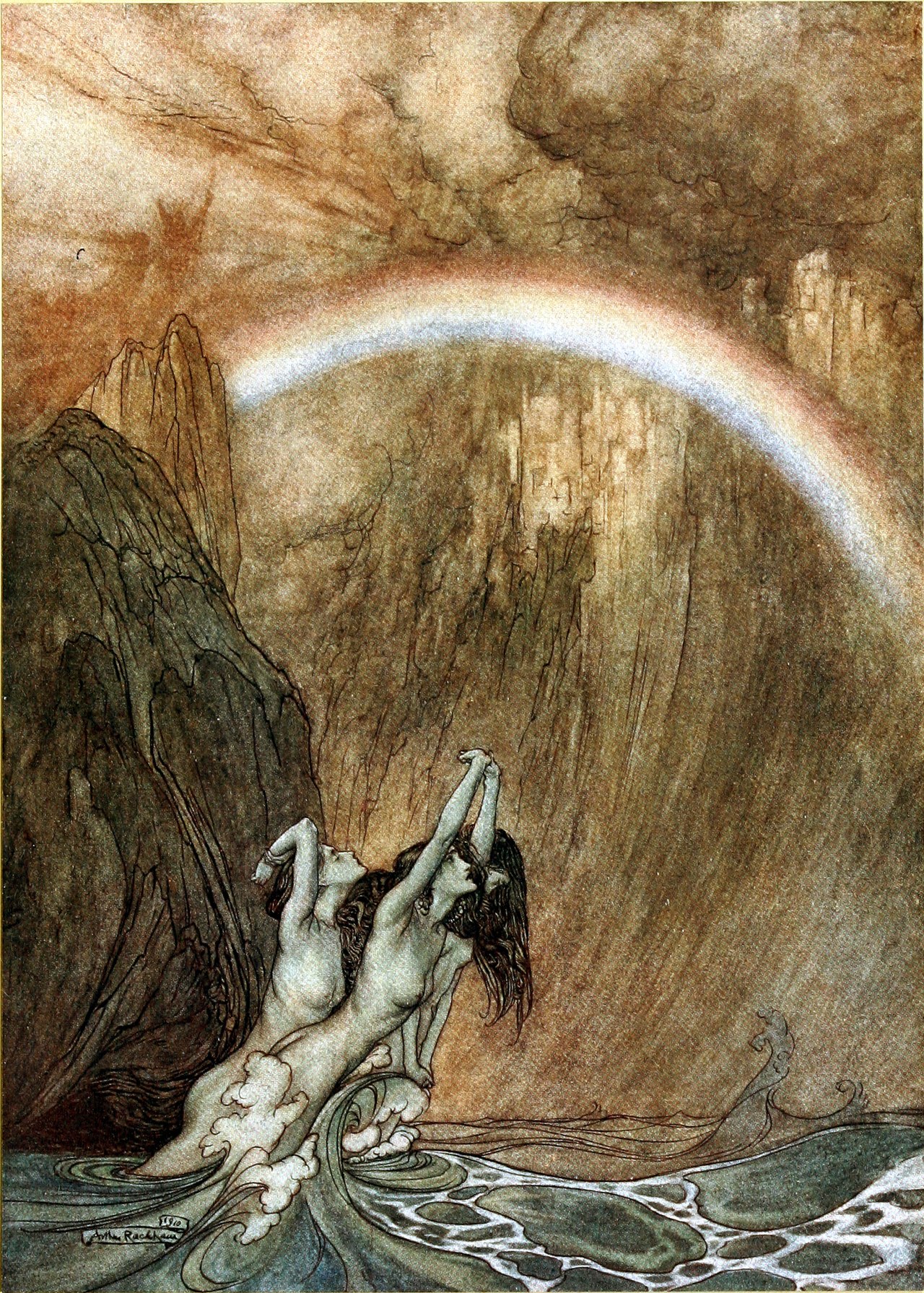
Note: This essay was originally published in VAN Magazine. All images are by Arthur Rackham from his 1911 collection.
I've long accepted the fact that I am one of tens of thousands of people who
suffer from Wagner derangement syndrome. Many people listen to or watch
the works of Wagner, but only an errant few become lifers. Given the sheer
baggage of Wagner and the irksome coincidence of our shared surname, this is, of
course, devastating. Many times I have had to explain myself and my behavior—that
is, a very public obsession with “Der Ring des Nibelungen”—and all I’m able to
answer with is: Well, there’s so much in there, you can lose yourself forever.
That being said, I’ve never been one for combing through the minutiae of leitmotif
categorization or other such musical rabbit holes. If anything, the music of the “Ring”
has been overstudied and its text understudied. It is a listenable piece of literature on
the scale of prestige television. A work of mythical syncretism, the sheer complexity of
the story leads one to the same obsessiveness as the vast specificity of its music.
However, it’s not just the story and its scoring that are responsible for so many long
days and nights of rumination, but also the time in which I’ve been watching, listening
to, or reading the “Ring.”
When I began writing a series of essays about the “Ring” in late October of 2024, the world
was, if you can believe it, a much more stable place. Since that time, the situation in
the United States has devolved into an atavistic, Walkürian chaos in which all norms
and institutions have been either hijacked or dismantled for the twin purposes of
enrichment for the few, and mass immiseration and terror for the many. We are all
Brünnhilde and the gods have locked us in a hot car.
Before January (ed. note: 2025), there was enough emotional room for me to keep a critical distance
from the cycle, which, then as now, I work primarily with as a text. This is why, as I
wrote in my first essay about the Wälsung twins, I basically agreed with Theodor
Adorno’s reading of the “Ring” as a fundamentally bourgeois work, which, while
systemic in scope and dialectical in logic, is rather bleakly anti-humanist when viewed
in its totality, something Adorno believed was also expressed in its music, especially
the use of leitmotif. But as I started working more through the characters of Siegmund
and Sieglinde, it became clear that my analysis and Adorno’s were beginning to
diverge.
By recentering the work around “Die Walküre,” an analytical possibility—really more
of a compromise—emerged in which the melancholic aperture of the “Ring” could be
shifted away from the right and towards the left. While I concede that the cycle
remains on the whole a work of bourgeois individualism whose political undercurrent
can be described as a conservative anarchism, I don’t entirely agree with the claim that
its sentiment is primarily cynical.
Perhaps this is because I needed it to be good, to end in fulfillment. The “Ring” had
since outlived its role for me as a topic of mere literary and musical fascination.
Strangely, the more time I spent with it, the more the cycle became both field guide
and allegory for real, unthinkable life. The more that life has disintegrated, the more
I’ve sought out its music and text as a means of distraction, consolation and
reassurance.
One is only able to feel and think this way because enough time has passed: not
only since midcentury’s fraught, post-Nazi relationship with Wagner—and
the (controversial) rehabilitation efforts made by Wolfgang and Weiland
Wagner at Bayreuth—but also since the height of postmodern cynicism. Adorno, for
example, wrote his left critique of the “Ring” in the 1930s, when Wagner was at his
most irredeemable. The 21st century has mostly been spent stripping the man himself
down to his problematic nuts and bolts and trying to reconcile a new era of liberal
politics with the work of a largely illiberal artist.
As far as performances go, the mixed
results of this effort have ranged from the 2006 Copenhagen “Ring”—a feminist
rendition in which Sieglinde, not Siegmund pulls the sword Nothung from the ash tree
—to the 2013 Frank Castorf Bayreuth staging wherein montage meets a half-serious
critique of oil meets an annoyingly triumphant belief in the end of history.
But history has clearly not ended, and the struggle underlying the “Ring” is more
relevant to historical conditions today than it was for the majority of the 20th century.
It may even be the first time the cycle has been useful as an allegory for our present
world system since the heyday of failed revolutions and runaway industrial capitalism under which it was written. If Adorno represented the left interpretation of the “Ring” at midcentury, then George Bernard Shaw, who, in The Perfect Wagnerite saw the
“Ring” (positively) as representational of capitalist expansion, was Adorno’s 19th
century equivalent, and perhaps, in sentiment, a better precedent for a new project of
radical interpretation.
And we need one! Our alarming moment of fascist ascendency calls for fresh readings
of the cycle more attuned to contemporary political reality. (You know, the
“Götterdämmerung” of it all.) That these interpretations can and perhaps should be
from the left owes itself to a present-day far right that is so stupid, anti-intellectual
and anti-art that Wagner no longer appears on the staff list of its pantheon of myth
and symbology. While not negating Wagner’s many despicable qualities, this does
grant audience members a little more breathing room than before.
My final verdict on the “Ring” is as a struggle between two dialectical forces: fatalism,
and conviction—in this case, that love, and by extension the human condition, should
triumph over power and greed. The fatalism of the “Ring,” Schopenhauerian or not, is
a relinquishment of agency in favor of the consolation offered by a definite end, while
its conviction seizes agency, real or imagined, in spite of—and perhaps also in service
to—that same end. One’s interpretation ultimately derives from who one thinks is the
winner of this core struggle. In a sense, all readings of the work originate from what
exactly it means when Brünnhilde jumps on Siegfried’s funeral pyre, immolating not
only herself but the gods awaiting their grim fate in Valhalla.
This central conflict is very much of our time. I vacillate wildly between fatalism and
conviction on any given day. Like many, I read the news and feel as though I’m
suffering a death by a thousand cuts. The more I read, the more I hear a little voice in
my head telling me that there is genuinely no hope, that my enemies have won with
such totality that the only real choice left for me is between fantasizing about leaving
the country (or perhaps the world) and succumbing to a prolonged emotional
breakdown as everything collapses around me. Disavowal is easier during the day. I
must work for a living. But late at night, when I am most at the mercy of my own
thoughts, I often find myself asking: If this is how you are going to behave in the face of despair, do you really believe in anything other than yourself? Is there nothing to be
found in this life that is worth fighting or suffering for beyond your own power, your
own material satisfaction?
This is when I start thinking about the “Ring” cycle.
Part I: "Das Rheingold" and "Die Walkure"
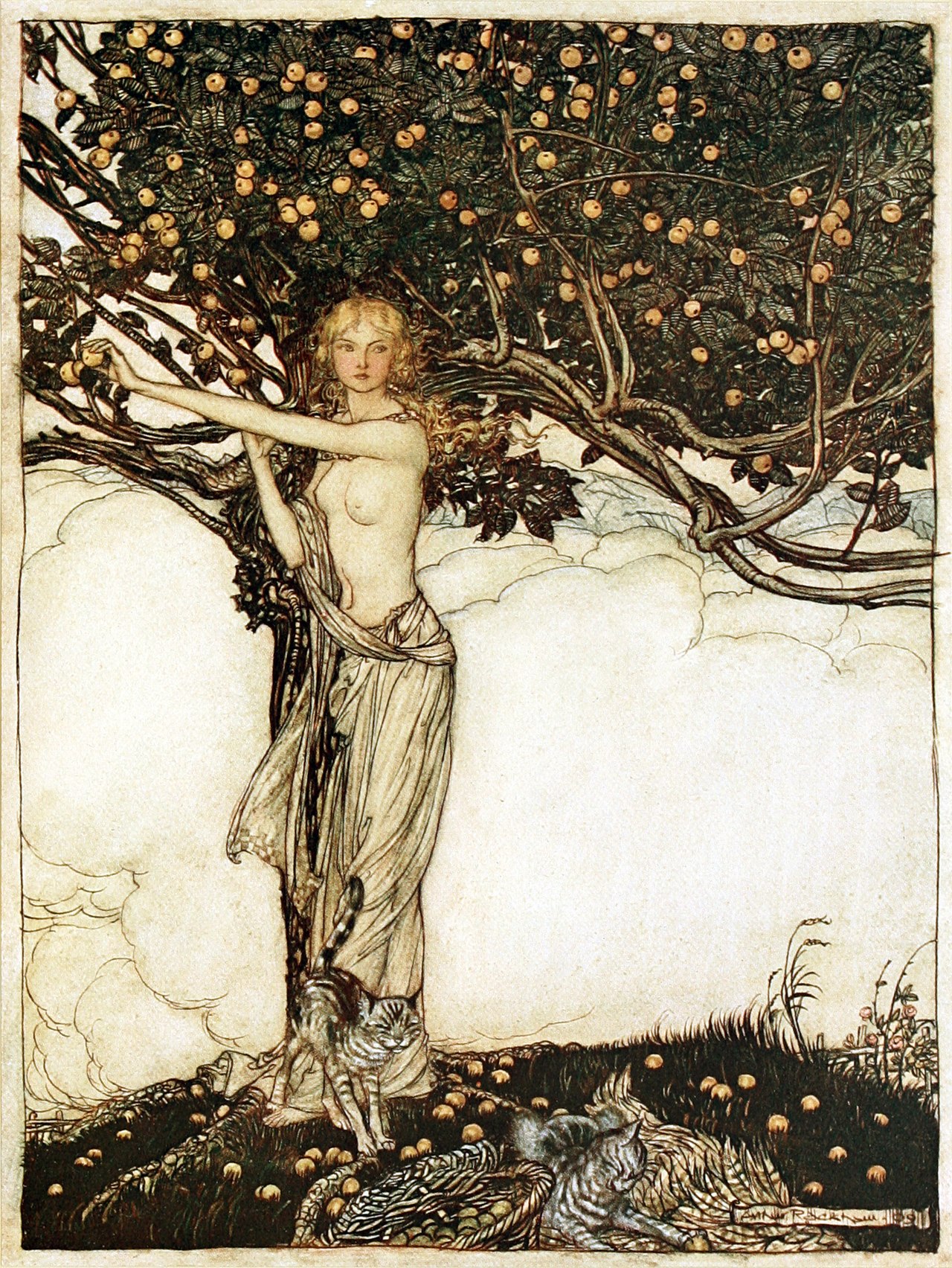
It is a dialectical fact that all systems contain the necessary ingredients for their
own unmaking; this forms the basic premise of “Das Rheingold,” where the
dwarf Alberich renounces love in exchange for greed and is rewarded with the allpowerful ring. However, within the cosmology of the cycle, this potentiality was
always there—the gold had long shimmered at the bottom of the river—but for
whatever length of mythical time, it remained unfulfilled, waiting for the right villain.
The same can be said of the arch-god Wotan, who stole from the World Ash Tree in
order to forge the spear of contracts with which he conquered the world. Like the
gold, the World Ash Tree stood peacefully in the realm of the Norns, protected by
otherworldly constructs, yet always at risk of someone coming to do the unthinkable.
This violation of nature, echoed in the gold, created a hypocritical contradiction which
repeatedly manifests itself in Wotan’s lax adherence to his own godly rules. When we
meet him in “Rheingold,” he has already become a being that is simultaneously
lawless and lawful, weak and all-powerful.
Wotan will come to make a lot of bad deals, but the one that proves fatal is his theft of
the ring from Alberich. Using guile, he pilfers the ring to pay the giants Fasolt and
Fafner for the work they put into building the palace of Valhalla. This payment comes
in lieu of the goddess of youth, Freia, who was the original reward both parties agreed
to. Here a second fundamental construct of the cycle has already been established. The
Norns (back in deep, primordial time), the Rhinemaidens (who protected the gold)
and Freia (the fair) are the first of the women—all women—in the “Ring” who will in
some way be violated and wronged by men. To the gods, to Alberich, to the
Gibichungs in “Götterdämmerung” and to Siegfried (who ultimately does their
bidding), woman is primarily an object of extraction and exchange. Perhaps the truest
pessimism in the “Ring” is the pessimism of womankind.
Incensed by Wotan’s theft, Alberich curses the ring, making it, too, a paradox of
ultimate power and terrible weakness. Only misfortune will befall those who wear it,
and those who don’t have it will endlessly long for it—Fafner kills his brother Fasolt in
order to maintain control of it. For what purposes? What reward? To spend the rest of
his days lurking in the woods in the form of a dragon, a pitiful hoarder of that which
will destroy him. But something even worse is waiting in the wings. Near the end of
the opera, Wotan receives a visit from Erda, the omniscient Earth Mother, who reveals
to him that the once-deterministic future has been fractured, and, as long as the ring is
in play, the end of the godly ancien régime could come to pass. We later learn that
Wotan, in his inextinguishable greed, will rape Erda simply because he is not satisfied
with the piecemeal knowledge she’s initially given him and hopes that, through
coercion, she’ll give him more. The result of this union with Erda is the Valkyrie,
Brünnhilde.
It is only in “Die Walküre,” the cycle’s most important installment, that the
conflict between fatalism and conviction—rather than the expected conceit of
who does and does not have the ring—separates characters into opposing forces.
The terrain for which these forces battle is the now-unmoored present: in other words,
the unknown. Crucially though, Wotan does not begin this chapter as a fatalist. In
fact, he is the opposite. For the first time in his life, he is afraid. And, as is often the
case with men in power, his fear is sublimated through tyranny.
The gods of the “Ring” are essentially an elite class that rule over human beings, who
to them are nothing but faceless slaves devoid of free will. Up until now, this was a
mostly one-sided if stable arrangement in which humanity lived out a meager existence
mediated by reasonable amounts of divine intervention. After the theft of the ring,
Wotan decides to use humanity as an exploitable resource with which he can wage
war with Alberich. He does this by plunging the human world into endless, senseless
violence, the scale of which is only revealed in Act III, when the Valkyries
(accompanied by the “Ride”) are preoccupied with heaping a cavalcade of dead bodies
into a pile. In the human realm, warriors fight and die unceasingly for no other
purpose than to assemble an army theoretically capable of reclaiming the ring before
Alberich can, or in case Alberich does. This, however, is a plan with many
contingencies; hence, Wotan takes matters even more into his own hands by
wandering the earth under the pseudonym Wälse, and siring, with a mortal woman,
the Wälsung twins, Siegmund and Sieglinde.
I strongly believe that any positive radical interpretation of the “Ring” has to begin
with and be oriented around Siegmund and Sieglinde. To me, they are the most
important characters in the entire “Ring.” It is not only that they are heroes and
(problematically incestuous) lovers, they are the cycle’s truest heroes and its only
lovers, as both their heroism and their love are rooted in something other than
determinism. More than the ambiguous ending of the cycle, the twins ask and answer
important questions about humanity: Without the intervention of the gods, of the
powers that be, what could we accomplish? What does it mean, being human? What
does it mean to be good, to be righteous? What can we make of this terrible world
we’ve been given? The answer that emerges is not only one of love, but solidarity.

I think about Siegmund and Sieglinde all the time. Like, I don’t think there’s a single
day I don’t think about them. I keep them very close to me in part because I see them
as a model for how to maintain one’s own humanity at the absolute nadir of despair.
To summarize what I’ve written in a series of four essays on the topic: Siegmund is
born into Wotan’s miserable world, renounced by the gods (it’s mutual), orphaned,
and made to endure endless abjection and a life of exile, all because Wotan implicitly
believes that human freedom can only come from alienation and suffering to the
extent that one loses any faith in a higher power. The same is true of Sieglinde. Here,
the degrading existence Siegmund must endure is interiorized and refracted through a
domestic lens, as Sieglinde is forced into marriage with the rich tribesman Hunding, a
man who brutalizes her verbally, physically, and sexually.
It is precisely because of this hard-earned freedom that Siegmund is able to see
Wotan’s world for what it really is: cruel. However, Siegmund’s long dinnertime
testimony in Act I, Scene 2 demonstrates another underlying opposition to the godly
order. Siegmund suffers under a patriarchal warrior culture of honor and shame, and,
having been thoroughly othered by that system, he is able to repeatedly recognize and
identify with the suffering of women at the hands of men. (One can even say that,
following the way Hunding treats his guest, Siegmund is a feminized figure.) Through
this mechanism of empathy, Siegmund is the only man in the entire cycle who does not
see women as a means of extraction or exchange. Even before he meets Sieglinde, this
shared protestation against exploitation and suffering is the conviction that drives
Siegmund’s actions, despite the fact that it never once works out for him. This is
because, for Siegmund, good is what one does, not what one is.
Sieglinde, meanwhile, is often maligned as a stereotypical seductress or damsel in
distress, waiting for the right man to save her, for which she will reward him with sex.
A typical opera woman! I have never liked this characterization. No hapless Elsa is
Sieglinde. If we look a little closer, Sieglinde very much resists the same injustice as her
brother. She, too, refuses to be objectified, a refusal in which Siegmund serves as both
comrade and leverage. This is most evident at the end of the second scene wherein
Hunding, for all intents and purposes, threatens to rape his wife. Siegmund looks at
the two of them in horror; Sieglinde tries to gesture at the sword in the tree. But
something more important transpires a little later in the background: She laces
Hunding’s nightcap with sleeping powder. One wonders why Hunding has such a
powder in the first place. His long-suffering wife surely knows. And this is the thing
about Sieglinde: whether it’s the drug or the fragments of the sword, the tools of
subjugation are used by her, albeit incompletely, to unmake their wielders’ world.
Siegmund (famously!) does not save Sieglinde. It is far more useful to see them as a
pair, two soldiers in the same battle—individualized, as all things are in the “Ring,”
for emotional and corporeal autonomy, and against cruelty and shame.
It is at this point where we must talk about love. It’s always been a belief of mine that
Wotan never intended for his children to fall in love with one another—in part because
that love puts them under the jurisdiction of Fricka, who has, as we will see, many
reasons to thwart her husband’s plans. And yet, Wotan himself created the conditions
under which such a love was all but inevitable. These conditions of privation and
loneliness are also what grant such love its profundity. The love between the twins is
utopian, built on mutual compassion and shared acknowledgement of suffering, and is
thus unlike any other love in the “Ring.” When Sieglinde sees Siegmund for the first
time, he is desperate, weak and injured. Like her, he has nothing, not even his own
name. Sieglinde shares this state of namelessness with this stranger, her brother. When
Siegmund asks who she is, she identifies herself only as the property of her husband,
no different than the four walls that surround her. Because Siegmund is the woeful
recipient of naught but misfortune, once this miraculously kind stranger has tended to
him, his immediate thought is to leave her be so as to not bring any harm upon her.
What does Sieglinde say to him when he informs her of this?
“Nicht bringst du Unheil dahin,
wo Unheil im Hause wohnt!”
(You can’t bring calamity into the house
where calamity lives!)
(I’ve chosen to use English quotations—sourced from the John Deathridge translation
—in this essay for reasons of brevity.)
And so they wait for the husband, who immediately barks at the wife to prepare a
meal and, at the dinner table, interrogates her guest, whose presence undermines both
Hunding’s sexual and political authority. Imagine what it must be like to be Sieglinde,
how it must feel to hear the stories of a man who suffers similarly, who risks his life to
defend, of all things, a girl being forcefully married off by her brothers, and for no
other reason than because it is just? Is there any wonder that, in doctoring the drink,
Sieglinde risks her life to save Siegmund’s? Alone in the night, she tells him everything:
about her own sham wedding, the sword, the mysterious yet familiar wanderer who
left it for her. She speaks to him in the hushed language of comradeship, and he
returns this speech in kind. He will free the sword and liberate her. Through
tenderness, she has already liberated him. This solidarity is the bedrock upon which
love is built.
The twins’ love is one of mutual identification, a recognition of the self in the other
through which alterity is eliminated altogether. This recognition creates a narrative
momentum that carries the rest of the first act. It manifests in the guessing and gazing,
the hesitant questions, the hands caressing faces, the peals of voices, the metaphor of
love-sister and spring-brother whose unity will drive out the chill of winter, all
enveloped in a music of bliss. We know how it ends, passionately on the bearskin rug.
(Long live our Wälsung blood!) But rather than being an aberration, incest, for
reasons of structural misogyny within the “Ring,” is a necessary precondition for a
utopian love like this. It reflects an understanding of gender in which true parity
between man and woman is unnatural and unrealistic. Hence, for there to be no self
and other, that man and that woman must be literally, physically the same. Siegmund
is Sieglinde, and Sieglinde is Siegmund. They are part of the same fate, the same
project, the same physicality. There cannot be one without the other. Fraught as it may
be, this problematically realized absence of otherness is also what makes the twins’
love so moving and why generations of listeners have been willing to begrudgingly
accept it.
Part II: "Die Walküre," cont.

In the “Ring,” fatalism and conviction battle on a terrain of the unknown. What I
mean by that is: through the forging and theft of the ring, the world order has
been pushed into a state of instability. What comes after such a moment will be
by necessity different from all previous experience. Like all historical conditions,
especially the one we’re living in right now, this post-ring world is unique. It can only
be dealt with via novel means mined from the same stuff as the condition itself.
As we have seen, Wotan responds to uncertainty with further despotism, rooted in a
desire for control, and a need to reset things to the way they were—even though this is
all but impossible. (As they say, the only way out is through.) Siegmund and Sieglinde
are a threat to this same status quo. As a free man and a free woman, the twins
present a structural challenge to godly supremacy, and thus an unresolvable problem
for the world order. Fricka sees this. Under the guise of propriety and anger at her
husband’s infidelity, she demands that Siegmund, her rightful slave, be killed in service
to her honor. Wotan, then, is faced with a choice, the same choice as Alberich, and
later, the same choice as Siegmund: Will it be power or will it be love?
At this point, the contradictions once underlying Wotan’s world have now undermined
it. He realizes that his plans for the ring, his compassion for his son, and his ability to
have total dominion over the way of things, are all crumbling before his one eye. And
so his despotism transforms seamlessly into fatalism. Let the gods fall, Wotan tells his
daughter, Brünnhilde. All that is left is the end. In anger and despair, Wotan forsakes
agency, and, though he makes a few desperate attempts in “Siegfried” to understand
the goings on of the world, he can no longer intervene in a substantial way and
relinquishes the desire to try.
Back on earth, Siegmund is also presented with this same unknown, this same
futureless world—replete, even, with mass death and interminable pain. Yet unlike
Wotan, he can see a fundamental truth: that what is known is just as, if not more
intolerable than what is not known. Siegmund’s temporal domain is the present. He
acts in spite of grand narratives, possesses no teleological beliefs in an ultimate justice
or a resolution of strife. Existence is only what he makes of it in service to what he
believes. When he reunites with Sieglinde, his love for her becomes so meaningful to
him that he will do anything to not only protect and nurture it, but to shape his world
in love’s image: to go forth into that great if indeterminant springtime.
For our contemporary purposes, it would be a mistake, however, to claim that
Siegmund does any of this out of a sense of hope. I don’t really believe that there is
any hope in Siegmund’s life. There is an almost existentialist quality to the way he
aimlessly perseveres after enduring abuse after abuse, defeat after defeat. (The same,
frankly, can be said of many of us.) This shrugging off of hope is not, to be clear,
nihilistic in sentiment precisely because Siegmund possesses no telos, no true certainty
about what will happen and his role in it. This is evident from Siegmund’s very first
meeting with his sister (who he does not yet know is his sister). In fact, one can say
that she gives him this conceptual freedom. On the threshold of her hearth, he tells
Sieglinde, “Misfortune pursues me, wherever I flee; misfortune pulls me closer,
wherever I stay – You, woman, may it never reach! On foot and alert, I must be
gone.” In accordance with his previous experiences, he will keep going. He will move
on. And yet, at the first sign of a different outcome, he abandons his certainty. He
reorients his entire life because Sieglinde, who suffers herself, does not want him to go;
because, despite what he’s told her, she asks him to stay; because they share a fraught
resilience.
Love is the most important force within the “Ring.” It sharpens conviction into a
spear with which the world can be won or lost. However, it would be wrong to draw
an equivalency between love and hope. Love rewards Siegmund with hope, but it also
rewards him in other, more important ways: with sustenance, direction, the power of
solidarity, a greater will. It’s no wonder, then, that after Wotan’s other illegitimate
daughter, the Valkyrie Brünnhilde, visits Siegmund and warns him that he is going to
fatally lose his battle against Hunding—albeit in exchange for the endless pleasures of
Valhalla—Siegmund rejects her and Valhalla, too. Of course he does, because, unlike
his father, he believes in something other than himself.
Sieglinde is no mere object that can be exchanged for some reward. Siegmund’s place
is with her, with humanity. Compared to the tangible depth of human love, eternal
bliss rings pretty hollow. As a result of this renunciation, Siegmund dies, at the hand of
his own father, for love. He does this not because he is stubborn or arrogant or foolish
or inherently tragic but because conviction is all there is. As a character, he forces us to
acknowledge the burden of our own agency. In the end, his is a right to die.
The lesson we should take from Siegmund is not that we should live and act as though
there is no hope, but that hope cannot be discovered or lost. It can only be created by
the choices we make, forged in the same fires as unadulterated belief. It is this
conviction contra hope that makes Siegmund a hero—the hero. This is why, though it
takes another two operas, it’s his vision of freedom through love that ultimately comes
to fruition. Such freedom can and must only mean the destruction of the system responsible for all misery and subjugation.

This distinction is not as politicized in “Die Walküre” as I make out here, in part
because the “Ring” is a pageant of individual actors. But the end, as viewed through
the lens of Siegmund, gives depth to his struggle and offers us something to hold onto
in the gray waters of the unknown. Siegmund dies in that realm, as does Sieglinde, as
have countless revolutionaries who never got to see their vision of a better world come
to pass, albeit in ways that they could not have possibly foreseen, and which often
tread a longer path of struggle they or anyone would’ve wanted.
In the “Ring,” the synthesis of our two competing forces is Brünnhilde, the final
hero of the cycle and by far Wagner’s most progressive female creation. But to
become that hero, Brünnhilde must first overcome an attachment to both her
father and the privileges of godhood—and that’s before we even get to Siegfried.
“Die Walküre” shows Brünnhilde at her bravest. She schemes against her stepmother
and pleads with her father to let Siegmund live. When he refuses, she struggles to
obey, tentatively following his commands only to reject them later on in lieu of her
own sense of morality. This choice exposes the greatest irony of the whole cycle,
which is that the mighty defender of the status quo that Wotan seeks is not Siegmund,
but Brünnhilde. He is unable to see what’s right in front of his face because his
daughter, brilliant though she may be, is a woman.
When Brünnhilde, serving her role as an envoy of death, visits Siegmund in the forest,
she tells him matter-of-factly what will soon happen to him: He will die in battle and
ascend to Valhalla where he’ll find beautiful women, endless charms, and be reunited
his father. When Siegmund renounces heaven in favor of staying (and dying) with
Sieglinde, his conviction persuades Brünnhilde to side with her half-brother instead of
(and in direct opposition to) her father. In this, she is naive but sincere. She hopes that
Wotan will see reason, will avert disaster at the very last moment. He won’t.
A woman of supernatural strength, the Valkyrie arms herself and tries to protect
Siegmund in battle, only for Wotan to overpower the both of them, shattering
Siegmund’s mythical sword and dealing the fatal blow. Upon seeing Sieglinde watching
in horror, Brünnhilde knows that atonement starts with her. In an act of compassion
for her half-sister, Brünnhilde flees the scene and later informs Sieglinde she’s pregnant
with a great and noble hero who shall be called Siegfried. However, to avoid the wrath
of her father, Sieglinde must roam the forest where the dragon Fafner lurks, because it
is the one place Wotan still will not tread. This fate does not faze Sieglinde.
Laughingly, almost, she descends into the great unknown with the fragments of her
lover’s sword, assured that they will one day be used to dismantle the forces that
shattered them.
Despite the efforts of the other Valkyries on the fell, parental discipline follows for
their sister. However, Brünnhilde has not entirely embraced Wälsung thought. Once
her father comes after her, the first thing she wants to do is negotiate, as she did
before, with the same patriarchal power that is all too willing to treat his own children
no better than objects. (Where else could Brünnhilde have learned how to negotiate
with Siegmund over the fate of a woman?) Now, as earlier, Brünnhilde holds her own
against her father because she does not fundamentally see herself as lesser than him.
(This is not entirely incompatible with her acceptance of his parental authority.)
However, a broader insight into Brünnhilde’s insubordination is that her actions are
based not only on her capacity for free will or sympathy for Siegmund and Sieglinde,
but also her profound disagreement with Wotan’s recent millenarian turn.
Brünnhilde ultimately disavows the same intolerable unknown that drove her father to
violence and her brother to his untimely end. She refuses to believe that things can’t go
back to the way they were. Her wish is to reset the clock to a time, not so long ago,
when Fricka wasn’t as involved in family affairs, when Siegmund and Sieglinde were
allowed to roam the wretched earth, when the slaughter of innocents brought good
work for the Valkyries—all under the watchful eye of her doting father. How, she says
to herself, could the world be ending when it remained perfectly intact so recently?
Why is Wotan, who maintains and upholds the structures of that world, all too willing
to comply with annihilation in advance?
This conflict between Brünnhilde and Wotan over Siegmund’s fate is ultimately
irreconcilable. All the Valkyrie can do is try and mitigate the patriarchal harm that’s
about to be inflicted on her. In a corporeal manifestation of his ownership over her,
Wotan cuts his daughter’s wings, taking away her strength. He puts her to sleep and
leaves her to the mercy of whatever man will find her first. Brünnhilde is unable to
avert this degrading fate, but she is able to negotiate a compromise around the level of
severity. Fine; she will become the possession of a man, an object for exchange and
extraction. But she manages to convince Wotan to encircle her with a wall of flames.
Only Siegfried, the purest of all heroes, a man who knows no fear, will be able to
rescue her.
Part III: "Siegfried"

For many years, at the top of the fell, Brünnhilde sleeps, and waits. We are like
her, in many ways. We long for what we imagine was yesterday’s stability. We
still yearn for norms predicated on an irreparable degradation of nature and
endless human exploitation, norms that were at least less aesthetically gauche and
better managed by the now rather feckless “powers that be.” The ugliness that once
lurked, if shallowly, beneath a despotic world’s gilded surface, has now been dredged
up by those who wish to see its most destructive potential fulfilled. Like the gold from
the Rhine, these potentialities have always come prepackaged with more “benign”
forms of capitalism, lying in wait for those willing to use them to do the unthinkable.
Ours is a system in which all of humanity, even those once considered special, is a
necessary sacrifice made at the nihilistic altar of insatiable greed. That is what the ring,
and its precursory renunciation of love, represents. These are the violent conditions its
existence brings to birth. A genocide on earth and mass suicide in heaven.
Like Brünnhilde, many of us once threw our lot in with those who were already
fighting. We tried to seize the moment, to intercede on behalf of humanity. And often,
especially in the last decade, we thought that moment would be ours. We created the
conditions for a hope that would be crushed time and time again. And yet, we say,
and yet, and yet! But none of us realized that this great hurrah was the last off ramp
before true disaster struck; before the boulder tore down the hill and crushed Sisyphus
under the sheer weight of all that spent effort.
As the system eats itself alive, many of us–though of course not all–are no longer
fighting like we did in our Wälsung days. Instead, we are like Brünnhilde, lying there,
asleep. But worse than sleeping: we are waiting—for Siegfried. And here’s the thing
about Siegfried, this savior, this great hero, who we hope will restore order to a dying
world: He is worse than nothing. Siegfried is not like Siegmund. Sure, he has
conviction, but it is insular. He believes in nothing beyond the borders of his own
body. His is a world of simple domination, a sleight of hand that equates heroism with
strength. Ebulliently, he harasses the antisemitic caricature that is Mime, his
stepfather. He mends his real father’s sword. He slays the dragon. He puts on the ring.
He examines the Tarnhelm—which allows him to assume any shape—and chooses to
pocket it, because, arrogant as he is, no form is better than his own. A bird tells him where to go and what to want, for he has no inner locus of desire or direction.
All that
stands between him and what he’s seeking is Wotan, dressed as a wanderer, and his
once mighty spear of contracts, which Siegfried shatters simply because the old man is
taking up too much pavement. And Wotan, after just a moment of hesitation, lets him.
Wagner’s intent is for Wotan to achieve some form of transcendence here, the final
development into who he needs to be. This transition from despair to acceptance is
supposed to humanize him. But does it really, in the grand scheme of things? After all,
for those he’s left behind, the old world has died, the new world waits to be born. As
the apocryphal Gramsci quote goes, now is the time of monsters.
These worlds are about to meet. Siegfried can see Brünnhilde, sleeping on a
mountaintop, surrounded with fire. Our great hero, sword in hand, runs through the
towering flames to claim her without a second thought; his entitlement holds no
bounds. When Brünnhilde wakes up and looks at Siegfried, for the first and only time
in his life, he is afraid. He fears this woman because now he has seen himself beyond
his own comprehension, reflected in the wide, soft eyes of the Other. Brünnhilde lets
Siegfried take her, for his being here is proof enough of what she wants to believe: that
someone will save the day and all will be right with the world. And so they embrace.
And so they sing, loudly, about radiant love, joyful death.
Of course, Siegfried has no real knowledge of what love is. To him it is intoxicating,
affirming, a matter of possession. It’s all he wants, until he’s told to want something
else. Brünnhilde, however, does know, because Siegmund showed her, and this to
Brünnhilde was worth losing everything, including her own dignity. In her new
situation, she imagines herself to be Sieglinde, the love object, the woman a man is
willing to die for. But Sieglinde was no less a quiet revolutionary than her brother.
When it became clear that her and Siegmund’s vision of love could be carried on by
the next generation, she endured nine months’ privation in the woods and died in
childbirth for it. The people and the situation here are different, and will come to pass
differently.
Part IV: "Götterdämmerung"

To watch “Götterdämmerung” is not so far off in sentiment from reading the
news, in that it also shows a slow-motion descent into needless, cynical
violence and misery, the likes of which only death can imbue with a higher
meaning. But as far as the “Ring” cycle goes, the tone of the last opera diverges from
the others. As I wrote in an essay on the character Siegfried, “Götterdämmerung” is
based primarily on the courtly intrigue of the “Nibelungenlied,” which is a very
different text than the Norse sagas from which most of the cycle is sourced. The
“Nibelungenlied” is an ugly story in which a slightly more likable version of Siegfried
is ensnared in a family plot to abduct and rape Brünhild, a woman that Gunther, the
patriarch of this family, is not strong enough to conquer himself. What ensues is an
agonizing train wreck of betrayal and revenge that ultimately leaves everyone, save for
a single knight and his aging mentor, either beheaded or bleeding out on the floor of a
Hungarian palace.
Wagner stuffs the front half of this story into the bodies of his existing characters.
What makes “Götterdämmerung” more relevant to contemporary events than its
medieval precedent is that, in the opera, all of these people are mind-numbingly
stupid. The Burgundians become the Gibichungs, a family with no morals and no
direction who have perfected the trifecta of lying, cheating, and stealing. Their aim is
for self-enrichment as much as pure wantonness.
Through the Gibichungs, there can be a view of the “Ring,” along more Marxist lines,
that the heart of its final tension is between the haute bourgeoisie—the gods—and the
petite bourgeoisie—those who have made their riches here on earth, beginning with
Alberich, who steals the promethean fire of exploitation and uses it to light the
Nibelungen mineshafts as his brethren toil for gold. But much time has passed since
then. Wagner’s Gibichungs are not imbued with the same superstition as his old
villains and antiheroes. There is no talk of the Norns, the gods. This is not the slavish
humanity puppeteered into conflicts and harvested by Valhalla. As far as who rules
whom, the lines aren’t so clear cut between old and new, man and god, good and evil.
The time of Siegfried was an interregnum during which human society changed significantly.
This makes some sense if we think of the “Ring” as a 19th century work, emerging
from a similar socioeconomic transformation in society, or even as a work of our own
time which mirrors that transformation as the accumulation of wealth and power
escapes the grasp of old political structures. The warrior class represented by Hunding
has been civilized. Siegmund, the long-suffering proletarian (or more accurately, a
liberal subject), still persists in his half-sister, in those mute faces that surround Hagen
waiting for guidance, and perhaps even in Hagen himself. Adorno made the salient
point that when Siegmund rejects heaven, he by corollary aligns himself with Alberich,
even to the same (hotly contested) bit of music, the renunciation motif, when he pulls
the sword from the tree. But that was the old generation, whose ties to the new exist
primarily in the living memory of Brünnhilde. Many times, she fails to adapt to the
world she wakes up in.
Hagen, the loyal vassal of Gunther and the villain of the first half of the epic poem, is
transformed by Wagner into Alberich’s son and Gunther’s half-brother, whose main
goal is not helping his liege lord but, of course, getting his hands on the ring. Hagen,
however, is a richer character than his father. He has one foot in the heady world of
rings and dragons and the other in this new, hierarchical human existence. Hence, the
character he is closest to in sentiment is not Alberich, but Siegfried. Both are an
expression of Wagner’s predilection for what can be called a conservative anarchism.
Siegfried is an anarchist par excellence. In what is supposed to be a representation of
total human freedom, he is a heat seeking missile in any environment he’s put in. Like
Siegfried, Hagen believes in nothing. Like Siegfried, Hagen, to whom Alberich comes
in a dream, is guided by blind, unavoidable fate—by the ring. He is given more
structure via scheming and intrigue, but Hagen’s ultimate end lies in unavoidable
destruction. He is as much a failure as a villain as Siegfried is as a hero.
When Siegfried arrives at the hall of the Gibichungs in search of adventure, instead of
threatening to conquer their lands, like a child he proffers everything he has.
(Fortunately, his poor socialization is humorous to others.) Rather than being the
beautiful princess Siegfried tries to woo, Gutrune is in on the scheme and offers him a
love potion that will not only erase Brünnhilde from his memory, but also erode his
consent, rendering him helpless against her charms and the ulterior motives of her
brothers. (In this respect, Siegfried becomes, albeit only temporarily, like his father: a
feminized subject.) Gunther then makes Siegfried an offer he (literally) can’t refuse:
Should Siegfried help him capture Brünnhilde for his wife, he will receive Gutrune’s
hand in exchange.
Meanwhile, Brünnhilde sits up on her hilltop none the wiser. While admiring her ring,
she receives a house call from her Valkyrie sister, one that echoes Erda’s visit to her
father in “Das Rheingold,” in that she warns Brünnhilde to get rid of that fucking ring
before something terrible happens. This visit demonstrates that things are not exactly
settled in Valhalla, but Brünnhilde vainly refuses the offer. The ring is a token of
Siegfried’s love, which for her is the most important thing in the world. This refusal, a
final opportunity to prevent disaster, makes what will inevitably happen next even
more brutal. It has taken this long, but the curse of the ring has finally been fulfilled in
the way both Alberich and Erda prescribed.
Siegfried, fatalism’s unwitting acolyte, follows the course fate laid out for him. He
dons the Tarnhelm, transforms into the shape of Gunther, reconquers the flames and
subdues Brünnhilde with violence. He rips the ring from her finger and returns it to its
own. The real Gunther then steps through the fire to finish her off, to add credence to
the claim, shown by Alberich, Hunding and Wotan before him, that rape is the true
arch-crime of the “Ring” cycle, a kind of marrow holding together its bones. This
scene is dissonantly paralyzing. It holds the viewer hostage, in part because it invites a
particular helplessness, one that says: nothing matters! Look at all that has come to
pass, only for it to culminate in this! That’s what I meant when I said that Siegfried is
worse than nothing: When his heroism is finally put to a real test, he fails
spectacularly. He complies, he falls in line. It’s a dangerous game, waiting for him,
especially with nothing but errant hope as collateral.
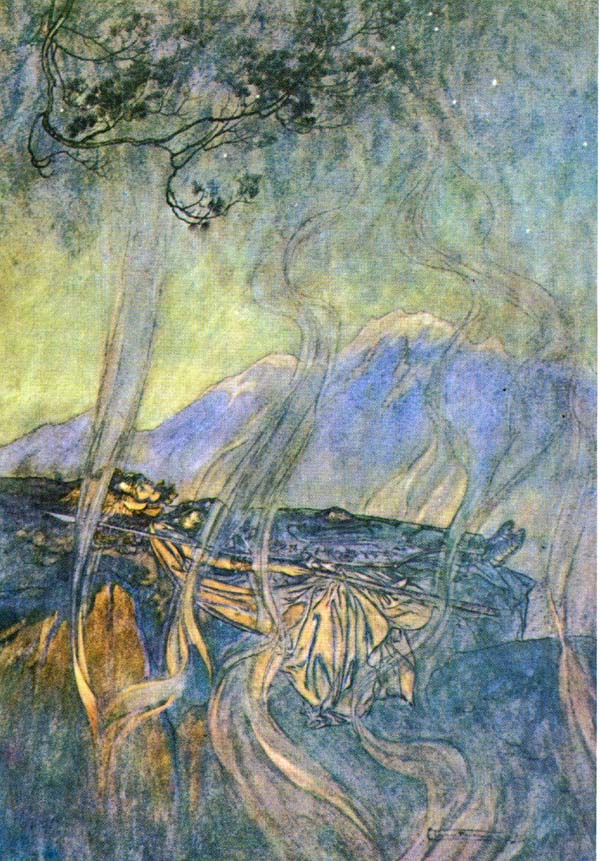
The cycle’s endgame is now in play. Because Gunther’s plan is as stupid as it is crass,
Siegfried gets caught out by Brünnhilde as soon as she returns to the castle: First,
because it is obvious that the real Gunther is incapable of actualizing the crime he
allegedly committed, and second, because Siegfried, rather than Gunther, is still
wearing the ring. This puts Siegfried in a situation where he lies and tells the truth
simultaneously, because he doesn’t remember that he and Brünnhilde were lovers up
until, well, yesterday, and so he also doesn’t remember that the ring was originally
given to her even though everyone else does. The Gibichungs immediately turn on
Siegfried: half because Gunther is revealed to be the biggest cuckold in literature to the
tune of massively injured pride, and half because they already hate Siegfried (especially
Hagen, for generational reasons) and his potential demise is convenient.
In the wake of this nasty confrontation, Brünnhilde, egged on by Hagen in the heat of
the moment, demands Siegfried be killed for his act of betrayal. After the abduction,
this is the second most dreadful moment in the opera because, despite all her agency
and all that she knows, Brünnhilde, too, chooses violence. However, in this case, one
must ask, is she entirely wrong to do so? Despite the misery of the moment, the
wretchedness of the trap she’s ensnared in, is there not a political distinction to be
made between Brünnhilde’s violence and the violence of Siegfried or that of her father?
After all, Siegfried has destroyed the life Brünnhilde has built both for herself and for
him. He has destabilized conviction. He has undermined what life is for. But worst of
all, he has enabled his lover’s violation in every possible way. And so, rather than
comparing her to the men in her life, is Brünnhilde really so different from Sieglinde,
who, in drugging the husband who rapes her says: I refuse to be subjugated?
Justified or not, the decision—and the duress it’s made under—is ugly; it forecloses
any possibility of happiness. Even though she immediately regrets her decision to kill
the man she loves, Brünnhilde is unable to walk it back. The rapidity of this sequence
reveals what’s frustrating about the Valkyrie: Wagner really can’t imagine what a
strong woman should be like, and so his creation is both groundbreaking heroine and
misogynistic trope, a collaborator with and an adversary of male power. She is noble
and defiant, vain and wrathful.
It is at this point in the cycle—the end—where the synthesis of fatalism and conviction
comes to pass. Siegfried goes off on his hunting trip with Gunther and Hagen from
which he will return with a pike in his back. The gods have quietly stocked Valhalla
with tinder, hoping for it to catch fire. Brünnhilde is certain by now that they,
including her father, have abandoned her not so differently than they abandoned the
Wälsungs. When upon the earlier sight of “Gunther,” Brünnhilde laments, “Wotan,
ferocious, barbaric god! Alas! Now I see the point of my punishment! To hunt me
down until I’m derided and disgraced!,” one can still find in her the long echoes of
both twins, the derided man and the disgraced woman. But it is when she waits for the
inevitable return of Siegfried’s body that the end of the world and her role in ending it
soon become clear. In this moment, there is commonality, perhaps even an empathy,
between her and her father, because she, too, has been persuaded into condemning
someone she loves to an early death. As the funeral pyre is stacked high, she sings
rhetorically to the gods:
“Do you know, how it came about? O you, immortal
keepers of oaths! Cast your eyes on my unfurling
grief; witness your guilt without end! Hear my
grievance, you noblest of gods! With his bravest deed
— which you so rightly wanted — you doomed him,
once he’d done it, to the curse that doomed you, —
the purest of men had to betray me, that a woman
might become wise! Now, do I know what you want?
All, all, I know all things, — all freedom has now
become mine. Also I hear your ravens’ whispers; this
instant I send them both home with their news,
awaited in fear. Rest, rest, you go! I take possession
of my heritage now.” (emphasis mine.)
Brünnhilde could be an entirely different kind of savior of humanity. She does not
have to die. But by this point, there is a tacit recognition of her own complicity in the
way things have turned out. She is a part of the same bad infinity, as Adorno put it,
that has harmed her. And yet, her errant behavior all this time is testimony to a
different tyranny: of choices, of agency, of the possibilities embodied within every
decision. Self-immolation may fulfill the desires of her father; this much is true. The
end still comes for the gods, as intended, but not in the way they intended. Certainty is
only one element of the dialectical relationship. It would be entirely unfair to say
Brünnhilde’s suicide is one of relinquishment, a mere concession to the bleak
inevitability of things as they were made and things as they are meant to be. If
anything, the opposite is true: imbued with this knowledge of all things, all freedom
has now become hers.
Like Siegmund’s before her, Brünnhilde’s death is ultimately a revolutionary act, even
if its characteristics and sentiments are mixed. It is still a choice, and one made for
love. It is Siegfried—and the idea of Siegfried—she dies for. It is Siegfried she calls out
for as the flames grow higher and higher, Siegfried with whom she wants to be in a
better world that wasn’t. Death is the final leap into that same unknown the Valkyrie
once found so intolerable. But she makes this leap for the same reason as her brother:
because what is known is worse.
Undeniably, this is a bourgeois fantasy of sentimental martyrdom, and the helpless
chorus of Hagen’s onlooking vassals shows an equally bourgeois disregard for the
many, rather than the few, that make up the true throngs of humanity. Yet within the
logic of the “Ring,” despite—or because of—all its contradictions, this is the only way
things could have ended: in a burning contortion of man and god, myth and history.
Fate may have fanned the flames, but Brünnhilde’s sacrifice, while devastating, has no
basis in her father’s nihilism because it is firmly rooted in her own anguish. She
chooses death because that is where love is and love is all there is. She dies, not
because the world as it was has been lost forever, but because that world—which
created her and Siegmund and Sieglinde and Siegfried and just as quickly snatched
them away—is unbearable.
To die is the completion of the Wälsung project, which is, at its simplest, to clear a
path forward for loving and being loved, to actualize the possibility of a life freed
from the heavens. The flames at the end of “Götterdämmerung” will rid the world of
both the ring and Valhalla. They will destroy all that oppresses, all that could be
salvaged to oppress again, all that stands as an impediment to human flourishing, even
though what will happen after the fire dies down remains unknown. Unknown, but
open.
It is precisely this openness that makes the “Ring” a more powerful work than if it
had a triumphant ending. This final contradiction between intent and actuality,
between the world we aspire to and how our aspirations are fulfilled is inherent in
how history comes to pass, the way reality differs from stories. The protagonists of the
“Ring” show us that the unknown, far from being a pessimistic void, gives our choices
and actions meaning. It’s why we, personified in the onlookers, should watch it all go
up in flames and think: May we all meet our moment as bravely, despite our flaws.
Return to Index