It is from the dialectic of Das Rheingold that the most important of the Ring’s contradictions materialize: the contradiction of freedom and unfreedom that materializes in the form of the ring’s direct and oblique curse. Before we get too deep into this distinction, however, it’s also important to point out that before all of this, beginning with the World Ash Tree happened, there was a world. Within that world there are a handful of characters (we can call them “elementals”) who are more ancient than or are outside of the drama that takes place between the gods and human beings.
These include Loge, Erda, the Rhinemaidens, and the Norns. What is common to each of these figures is that they are sources of extraction for Wotan, with the exception, of course, of the Rhinemaidens, who are a source of extraction for Alberich. Put simply, they are the earth from which the ring was stolen and the earth to which the ring returns and are thus excluded from the mechanism of the ring’s curse, which acts upon that world.
Within those upon whom the ring acts, the line between agency and fate is more of a spectrum.
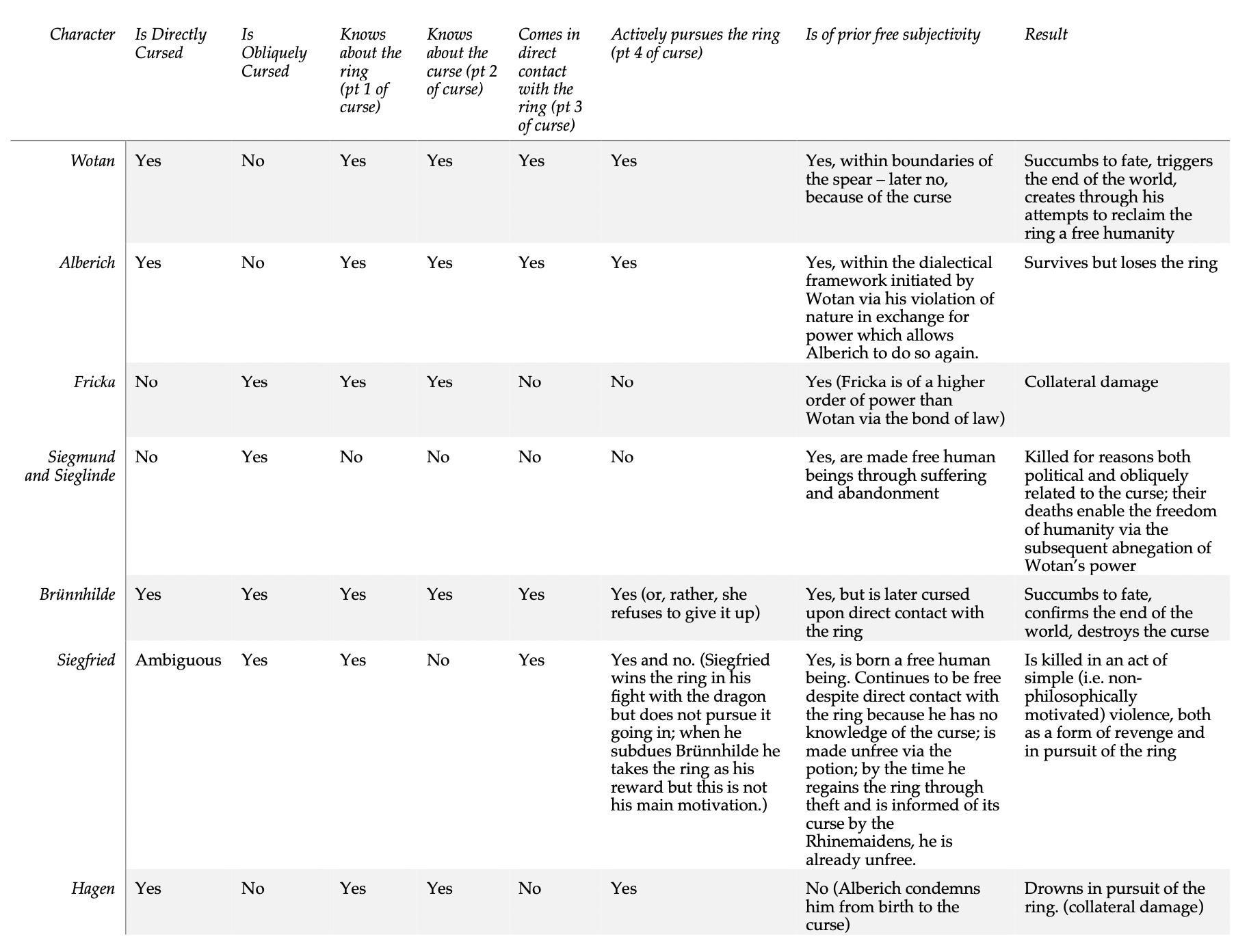
There is some uncertainty about at which point a character in the Ring becomes cursed by the ring. We can define a number of different stages thusly.
Unlike its analogue in Tolkien, for example, the ring's logic is not entirely consistent. Not all characters go through each stage of the curse, nor do they go through the stages in order. (In fact, to call them stages at all is a bit misleading.) The internal hierarchy of the curse is also questionable, however, one thing is certain, which is that actively pursuing the ring is the highest form of being cursed.
When we speak of "Direct" and "Oblique" curses, we mean the difference between this active pursuit of the ring and the violence incurred by the free by those who are unfree, i.e. by those subjected to the curse. This is the difference between, say, Wotan and Siegmund, who is perhaps the best example of the latter. Siegmund was created as part of Wotan's plot to reclaim the ring through the siring of a being who is independent of himself. However, because Siegmund is of free subjectivity, instead of doing what was intended of him (how could he have known to begin with?), he instead chooses a life of love with Sieglinde. This freedom, whose existence is confirmed by this love, is a threat to the power the gods have over man, which is the main reason why Fricka has Siegmund killed. Thus, he is free, but he incurs violence on behalf of the unfree.
The curse of the ring is at its simplest in Das Rheingold and only becomes more complicated from them. From the beginning Alberich is cursed by the ring by making it, Mime is cursed through Alberich's enslavement of him through the ring's power, Wotan is cursed by his theft of it, and the giants are cursed because they receive the ring as tribute immediately after the curse. These utmost direct curses are immediately deleterious, and this deleteriousness is sustained from the beginning of the cycle and on through Siegfried.
Fafner, immobilized by greed, condemns himself to the cave in Neidhöhle where he is to guard his treasure as a dragon for some forty-odd years. Mime, too, remains "ring sick," wandering the same patch of land until Siegfried comes along, with Alberich seemingly in close proximity. The only aberration in the latter's life is the siring of his son Hagen with the help of some leftover gold. Hagen, too, is directly cursed from the beginning because his father gives him the prime directive to pursue it. Wotan, of course, as a god, has more maneuverability that Alberich, but the curse is final, and Wotan enacts a great deal of violence in his attempt to break it. This violence includes those around him, the other gods, who are directly cursed by but who do not pursue the ring. It also includes characters broadly defined as collateral damage the most clear example of which is Hunding.
Things become tricky when we consider the cases of Siegfried and Brünnhilde, specifically. Each is an inheritor of the curse in their own way, but not necessarily directly. Brünnhilde becomes aware of the ring and its curse during Wotan’s monologue in Die Walküre, thus, we can say, that she is knowledgeable of both. That being said, she is not directly cursed by the ring (because she is not directly commanded to pursue it herself) until she comes into contact with it in the form of a gift from Siegfried who is, crucially, totally ignorant of what it is and also in no need of its true power. This gets us into the territory of knowing and unknowing.
What is unique about Brünnhilde also is that she is first obliquely cursed by the ring vis-à-vis her father’s violence towards her; this transitions, through physical contact with the thing itself, into the full, direct curse. From the moment Brünnhilde is given the ring, the curse as promised by Alberich plays itself out pretty much by the book, as Siegfried, the only person capable of stopping this process, is rendered by Hagen unable to do so. In Götterdämmerung, Hagen ensnares everyone else in his quest for possession of the ring; Brünnhilde, both because of Hagen’s guile but also out of her own personal quest for revenge, brings this conflict to a global pitch; subsequently, everyone dies. Dialectically this must also result in the returning of the ring to the Rhine.
Siegfried, in the Ring is the "yes, and." Like his parents he is born of free subjectivity. However, unlike his parents, his life is far more orchestrated for him by way of Brünnhilde's ensuring that Sieglinde give birth in the forest of Neidhöhle, thus actually putting him in a situation similar to that of Hagen. Surrounded by the characters from Das Rheingold Siegfried is lucky that the rest of them benefit from keeping him ignorant. When he is instructed by Mime to test his mettle against the dragon in the forest, Siegfried has no knowledge of the treasure until after he takes it from Fafner. Thus, he knows of the ring, and comes into direct contact with it, however because he does not know of the curse and did not pursue the ring for its power, he emerges from the situation miraculously unscathed.
The problem comes, as mentioned before, when he gives the ring to Brünnhilde as a gift. Shortly after, Siegfried's free subjectivity is taken from him via the love potion. This is the point where he simultaneously becomes a direct and oblique victim of the ring. The violence against him is committed by Hagen, and later Brünnhilde, the direct curse is that relating the ring itself, on his finger, which he's now, albeit in an altered state, pursued.
Return to Index